Insights
Community Infrastructure Center: A Theory of Change for US Infrastructure Investment







The US is facing an estimated $4 trillion infrastructure funding gap over the next 10 years, threatening our ability to preserve and enhance quality of life, public safety and resilience, and economic development for generations to come. State and local governments, historically the frontline funders of community infrastructure, are under increasing budgetary stress. Small, rural, and otherwise underserved communities face the worst infrastructure gaps, their capacity and resources too constrained to advance major projects on their own. How can we ease the technical and financial barriers communities face in advancing infrastructure development? Enter the Community Infrastructure Center (CIC).
Over four years ago, the Milken Institute’s 10,000 Communities Initiative created the CIC to help communities secure investment to build critical infrastructure, enable economic growth, and deliver affordable services. Community infrastructure projects run the gamut: the faith-based institution building a solar array that offers discounted energy to nearby households; the affordable housing developer retrofitting its portfolio of buildings to make units healthier and more comfortable; the rural county installing a fiber line to deliver high-speed broadband to a commercial corridor. These projects were stalling—not due to a lack of ambition or worthiness, but because we had not yet built the connective tissue linking communities with bold plans to the financial institutions with the capital to make them happen. The CIC’s theory of change addresses these barriers to project development on three fronts: predevelopment, capital formation, and market development.
Predevelopment activities include market studies, feasibility assessments, design and engineering services, the establishment of site control, and permitting. They are difficult to finance; traditional lenders see projects in the predevelopment stage as early, risky investments. Government and philanthropic predevelopment funds are limited and highly competitive.
The CIC aims to reduce predevelopment barriers by convening, sharing knowledge, and referring project sponsors to technical-assistance partners that provide low- to no-cost predevelopment support. We offer:
Capital formation means creating a workable “capital stack”—grants, debt, equity, incentives, and other resources—to finance a project. Capital formation is especially challenging for small and emerging project sponsors and projects in undercapitalized communities. Small project sponsors are more likely to lack experience, connections, and collateral to successfully finance a project. Many of these projects are too small to attract the interest of financial institutions, or they involve assets and technology—such as solar panels and batteries—that many lenders cannot yet confidently underwrite. Although government programs offer limited grants, incentives, and tax credits that decrease project costs, extensive compliance requirements and policy instability can make them less attractive. The CIC accelerates capital formation by helping project sponsors tell their story, form workable capital stacks, bundle smaller projects when possible, and connect investment-ready portfolios to investors. In our signature Deal Room sessions, curated groups of investors learn about promising projects and portfolios and can connect with sponsors to discuss possible deals in further detail.
To solve the infrastructure funding gap, community-scale projects must attract a wider range of investors. To foster this market development, the CIC is convening financial institutions and other experts to identify ways to facilitate secondary-market transactions that help community infrastructure investors recycle their capital faster.
Under the current “originate and hold” paradigm, a lender commits its capital to a single loan until it matures years later. We are trying to approach a new paradigm: “originate, sell or refinance, and originate again.” Here, the same dollar can finance several projects over a given period. This is possible only if community-based lenders can standardize their loans and bundle projects at sufficient scale to sell them to larger banks and financial institutions and then reinvest the proceeds to originate new loans.
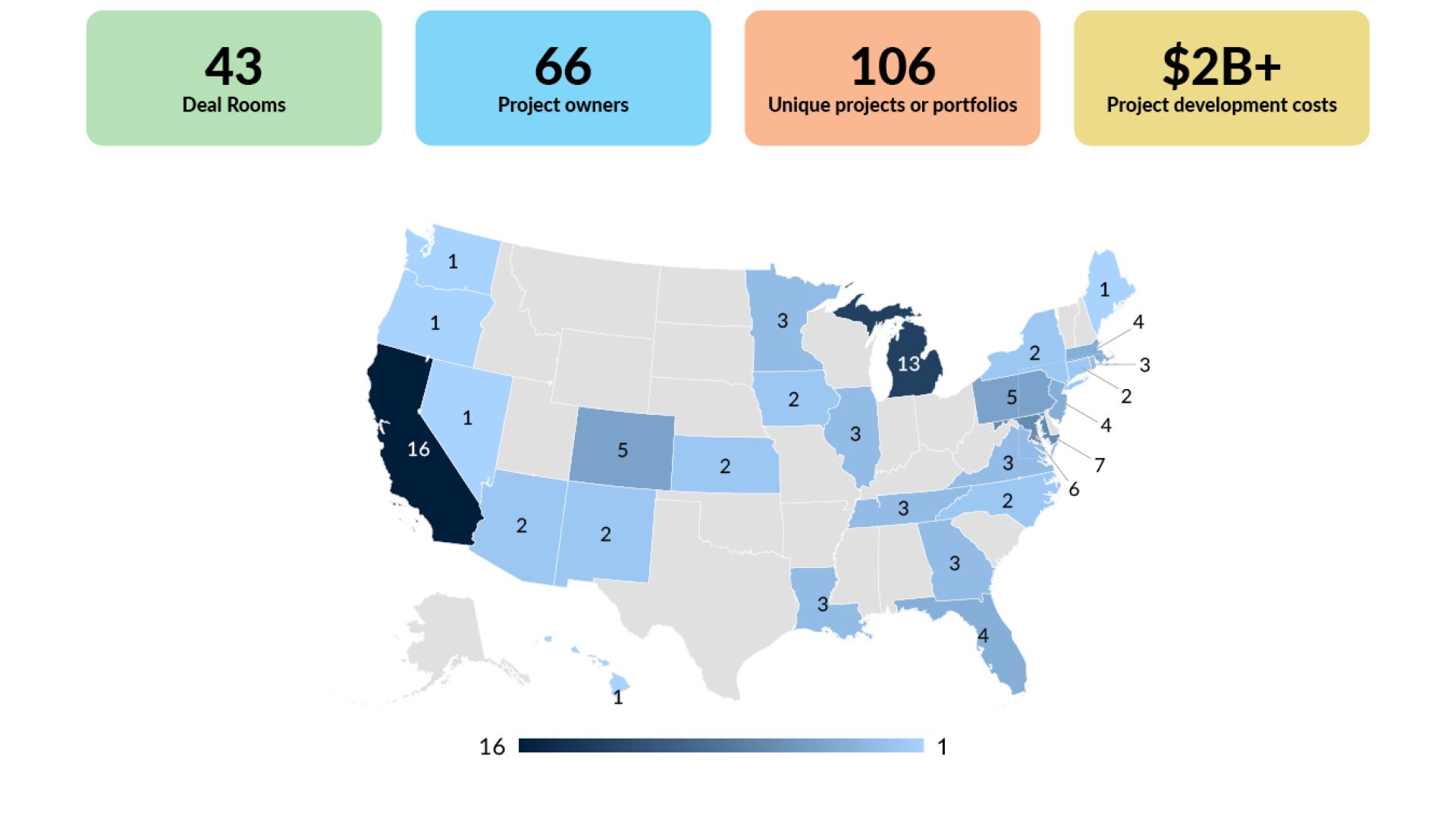
Now nearing the end of 2026, the CIC has built a national network and helped to demonstrate the opportunity in community infrastructure alongside our crucial partners and collaborators. More than 3,000 organizations and more than 800 projects now call the CIC home. In 43 of our Deal Rooms through the end of August this year, 66 sponsors pitched 106 projects worth $2.027 billion in total development costs across 28 states and territories (Figure 1). Millions of dollars in deals closed, advancing more than $100 million in development. More deals are currently in diligence. We believe that but for the CIC’s support, much of this investment would not have moved forward.
Figure 1: CIC Deal Rooms, National Numbers and Featured Projects by State (November 2024–August 2026)
We are clear-eyed about the work that remains in front of us. In 2027, we at the CIC will work hard to redouble our impact. We will continue to work within energy and housing while increasing our focus on broadband, water, and climate resilience; test what responsible AI can do to cut predevelopment costs and times; convene more forums where builders and financiers solve a problem once instead of 50 times; work with government to forge public-private partnerships that manage public budget limitations and drive economic competitiveness; build a strong pipeline of projects located in Qualified Opportunity Zones under the new Opportunity Zones 2.0 program; and build, with our partners, the transaction standards and secondary-market plumbing that will invite institutional capital to see this asset class for what it is. This isn’t charity. Community infrastructure promises real returns alongside transformative impact.
The talent and the capital both already exist. Our work is to keep closing the distance between them.
For the full story of the CIC and detailed market insights from the first 20 months of Deal Rooms, see our report. To learn more about the CIC, contact Savannah Richardson.





The United States is facing an estimated $4 trillion infrastructure funding gap over the next 10 years.


You founded Michael Maltzan Architecture in 1995, and your work spans cultural institutions, city infrastructure, and some of Los Angeles’ most recognized housing. What drew you to work at the...






 NJ




In its role as a global, nonpartisan, nonprofit think tank, the Milken Institute has launched an initiative called Investing in Europe’s Competitiveness. Its aim is to develop actionable steps to...