Managing Director, Future of Aging and Longevity, Milken Institute Health
Diane Ty is the managing director of the Milken Institute Future of Aging and Longevity, leading efforts to advance healthy longevity and financial security through a life course perspective on aging.
A New Name: Milken Institute Future of Aging and Longevity
This fall, the Milken Institute Future of Aging becomes the Milken Institute Future of Aging and Longevity. The change reflects what the work has become over 10 years: not only a response to an aging population, but a program dedicated to extending the years people live in good health, with financial security, purpose, and connection to their communities.
Our mission is unchanged. The Future of Aging and Longevity advances healthy aging and financial well-being across the life course through research, convenings, multisector partnerships, and the elevation of high-impact policies, practices, and programs. Our five practice areas—brain health, healthspan, home and community, financial longevity, and caregiving—remain the organizing structure for everything we publish and convene.
The Future of Aging and Longevity: A Decade of Progress, A Decade to Act
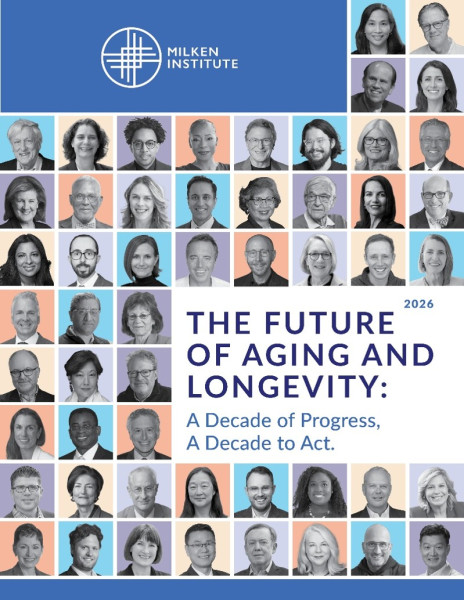
A decade ago, the Milken Institute published a series of essays imagining what longer lives could make possible and calling on the nation to prepare for an aging population. Ten years later, the case for urgent change has only grown stronger.
The Future of Aging and Longevity: A Decade of Progress, A Decade to Act brings together more than 50 leaders across academia, health, philanthropy, financial services, technology, aging services, and advocacy to assess what the last 10 years delivered and what the next 10 demand. A call to action and practical roadmap, this collection summons leaders in the public, private, and nonprofit sectors to build systems, workplaces, and communities that support longer lives; invest in people across the life course; shift outdated narratives, policies, and practices; and connect people within and across generations.
A decade of progress has shown what is possible. Read the full report outlining the call to action for the next decade.
Advancing Blood-Based Biomarkers for Alzheimer’s and Cognitive Care
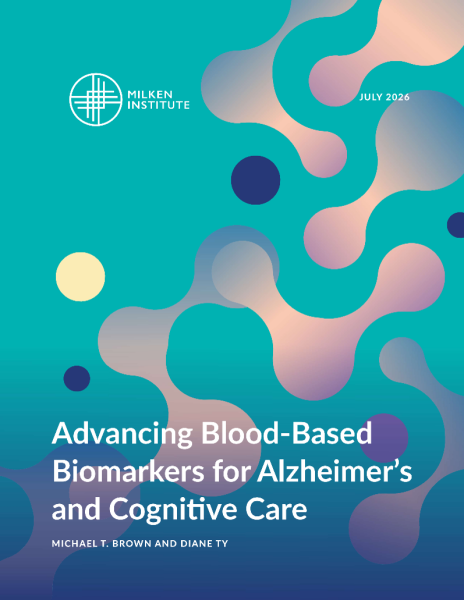
Released in July 2026, Advancing Blood-Based Biomarkers for Alzheimer’s and Cognitive Care asks a question the field has not yet answered: Now that ultrasensitive assays can detect Alzheimer’s pathology from a standard blood draw, is the health-care system ready to use them? Drawing on interviews with 32 experts, a survey of 22 stakeholders across six segments, a patient focus group, and a five-category readiness ranking, the report identifies the barriers and accelerators to widespread adoption, profiles four health systems already embedding blood-based biomarkers into cognitive care, and examines how coverage shifted for genetic testing as a precedent.
The report sets out concrete recommendations for making these tests the standard of care in both primary and specialty settings. Read the full report to see where the system is ready, where it is not, and what it will take to close the gap.
The Future of Aging led a private session at the 2026 Milken Institute Hamptons Dialogues titled “The New Science of Healthy Longevity,” Managing Director Diane Ty moderated the panel, which analyzed the latest evidence and innovations at the forefront of geroscience.
2026 Milken Institute Future of Health Summit
The 2026 Milken Institute Future of Health Summit takes place November 11–13 in Washington, DC. Be sure to join the livestream for the public panels led by the Future of Aging and Longevity below:
Future of Aging Advisory Board Meeting | Science, Systems, and Structures: The Next Decade of Aging and Longevity Wednesday, November 11, 1 to 3 p.m.
This section showcases articles, media highlights, and more, featuring Milken Institute Future of Aging and Longevity leaders as speakers, authors, or expert interviewees.
Articles and Op-Eds
September 2: Dawn Carpenter authored an article for the Stanford Center on Longevity titled “Rebuilding the On-Ramp to Adulthood.” In the article, Carpenter identifies the “missing decade” for today’s young Americans. This is the decade in which young adults learn independence and resourcefulness, building hard and soft skills that are useful throughout an entire life. The loss of this decade, resulting from delayed employment and independence, produces a compounding, future-altering reality that will have a resounding effect on careers and retirements for generations to come.
Stories from the Field
The Future of Aging recently published two Stories from the Field.
July 13: Aimee DeCamillo, global head of retirement and wealth, Manulife Wealth and Asset Management, spoke with us about how Manulife/John Hancock is increasingly focused on improving longevity readiness through personalized preparedness tools. The recent launch of the Longevity Preparedness Index, developed with the MIT AgeLab, offers clients the ability to take small, practical steps towards planning their retirement.
September 21: Ava Abramowitz, a former assistant United States Attorney for the District of Columbia, shared her story of being diagnosed with Alzheimer’s and the price of the silence of not getting tested. Recent diagnostic developments, such as those highlighted in Advancing Blood-Based Biomarkers for Alzheimer’s and Cognitive Care, have produced remarkable results in detecting Alzheimer’s. Abramowitz warns, though, that these developments are most useful for the most proactive among us, and calls for one simple message: Get tested.
External Events
July 10: The Alliance to Improve Dementia Care joined more than 11,000 attendees from 111 countries at the Alzheimer’s Association International Conference in London, July 12–15, featuring new work from the Alliance and hosting a dinner with Lord James Bethell, chair of the BARBARA Alliance.
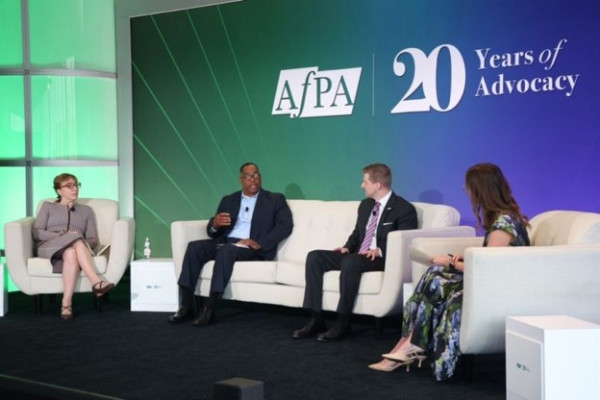
September 23: Milken Institute Future of Aging and Longevity Director Michael Brown spoke at the 2026 Alliance for Patient Access Summit on a panel titled “Early Detection and Personalized Medicine,” where he joined other experts to examine perspectives on how to improve patient outcomes, including empowering primary-care providers and making therapies more affordable through policy.
From left to right: Miriam O’Day, senior vice president, government relations, American Association for Respiratory Care; Johnny Boatman, patient advocate; Michael Brown, director, Milken Institute Future of Aging and Longevity; and Josie Cooper, senior adviser, Alliance for Patient Access.
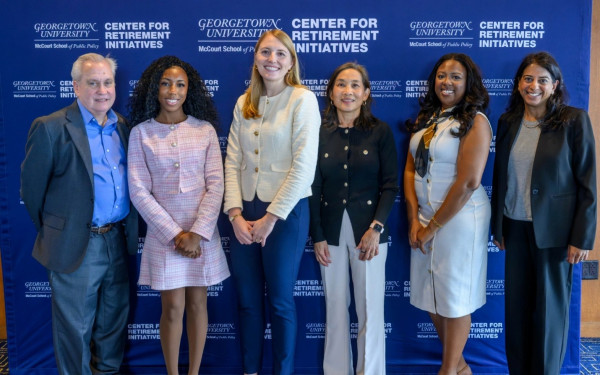
September 24: Ty spoke at the 2026 Family Caregiving and Financial Security Summit hosted by the Georgetown University Center for Retirement Initiatives, based in the Georgetown University McCourt School of Public Policy. Ty appeared on a panel titled “The Hidden Cost of Care: Protecting the Financial Security and Well-Being of Family Caregivers,” featuring a conversation about how caregiving shapes the financial security of America’s 63 million family caregivers.
From left to right: Richard W. Johnson, vice president, policy, AARP; Jaelyn Smith, youth lead with Lorenzo’s House; Anna Heard, policy director, health, National Governors Association; Diane Ty, managing director, Milken Institute Future of Aging and Longevity; Blaire Bryant, vice president, policy and advocacy, National Alliance for Caregiving; and Nisha Hazra, assistant director, US Government Accountability Office.
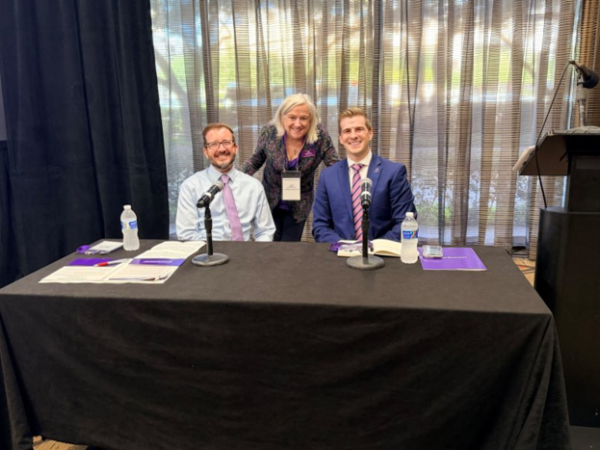
October 6: Brown spoke at the 2026 Alzheimer’s Association Healthcare Summit on a panel titled “The Dementia Care Business Case: Aligning System Value with Reimbursement,” joined by Peter Baker, program manager, geriatrics at MaineHealth, as they partnered to implement the Dementia Care Financial Modeling Tool developed by the Alzheimer’s Association Dementia Care Navigation Roundtable.
From left to right: Peter Baker, program manager, geriatrics, MaineHealth; Liz McCarthy, regional director of health systems, Alzheimer’s Association; and Brown.
Featured Interview
October 19: Ty was interviewed by U.S. News & World Report in an article titled “We're Living Longer. But Are We Living Healthier?” The article exclusively announced the release of The Future of Aging and Longevity: A Decade of Progress, A Decade to Act.
Media Highlights
July 29: The Future of Aging and Longevity report Advancing Blood-Based Biomarkers for Alzheimer’s and Cognitive Care was featured in an article from Today’s Clinical Lab titled “Milken Institute Calls for Wider Adoption of Alzheimer’s Blood Biomarker Testing.” The piece frames the Institute’s findings within a rapidly evolving regulatory and reimbursement landscape.
August 21: Ty was quoted in an article from Aging in America News titled “Forever Young.” The article examines a new documentary exploring the societal effects of our increasing longevity.
August 27: Brown was featured in a Milken Institute Pocket Studio Video to explain the findings in the Advancing Blood-Based Biomarkers for Alzheimer’s and Cognitive Care report.
September 16: Brown was featured in an article from STAT titled “Dementia Should Be a Campaign Issue—Not an Insult.” This piece focused on interviews with leaders at three national dementia organizations: Brown, Robert Egge of the Alzheimer's Association, and George Vradenburg of UsAgainstAlzheimer’s. Brown makes the bipartisan case and supplies the column’s central argument about language. “Dementia is truly a bipartisan issue that affects everyone,” Brown is quoted in the article, citing polling that 58 percent of voters have been personally affected by Alzheimer’s.
Brown was also interviewed for an article from Aging in America News titled “Blood Tests and Alzheimer’s Diagnoses.” Brown gives expert insights into the gaps identified in Advancing Blood-Based Biomarkers for Alzheimer’s and Cognitive Care between scientific progress and system readiness, highlighting where adoption is lagging across primary care, specialty care, and health plans.
September 18: For its September issue, The Dark Report published “New Report Outlines Barriers to Alzheimer's Blood Tests,” a feature built on an interview with Brown and the Advancing Blood-Based Biomarkers for Alzheimer's and Cognitive Care report.
The Alliance released Advancing Blood-Based Biomarkers for Alzheimer’s and Cognitive Care in July and has spent the months since translating it into practice. At the August all-member meeting, Cassie Ricci, senior manager of alliance development at Roche Diagnostics, and Matt Farber, senior director of Alzheimer’s disease advocacy and professional relations at Eli Lilly, discussed the report’s findings and the current landscape for blood-based testing. The conversation centered on reimbursement and insurance coverage, the absence of clinical guidelines, and appropriate use in primary versus specialty care.
Building directly on that discussion, the Alliance convened a design-thinking roundtable in October to turn the report’s recommendations into implementation tools, education, and training for health systems and clinicians.
On the policy front, the House Ways and Means Committee unanimously advanced the bipartisan ASAP Act, which would remove the statutory barrier to Medicare coverage of early Alzheimer’s detection tests.
News from our Alliance Steering Committee members:
AARP expanded its 211 Caregiver Support Program to 10 additional states, bringing coverage to 32 states and Puerto Rico and reaching an estimated 36 million family caregivers. AARP also published new research finding that nearly one in three family caregivers—about 17 million Americans—are also raising children, with 48 percent in high-intensity caregiving situations, up from 36 percent a decade ago.
The Alzheimer’s Associationlaunched the Brain Health & Quality Care Initiative on October 6, a national quality-care framework beginning in primary care that will provide evidence-based guidance, implementation resources, and professional education on risk reduction, cognitive assessment, diagnosis, and referral. Fellow Steering Committee members Eisai and Lilly are the initiative’s first founding partners.
The Alzheimer’s Association also hosted the Alzheimer's Association International Conference (AAIC) 2026 in London, drawing more than 11,000 registered attendees from 111 countries, and announced PROTECT-Cog, a $100 million global prevention trial pairing the US POINTER lifestyle intervention with a metabolism-targeting drug.
The Alzheimer’s Drug Discovery Foundation (ADDF)launched a $5 million Diagnostics Accelerator partnership with The Michael J. Fox Foundation targeting co-pathologies shared across Alzheimer’s and Parkinson’s disease, and marked the US Food and Drug Administration (FDA) clearance of C2N Diagnostics’ PrecivityAD2, a test ADDF seeded in 2008 and backed with $7 million through the Diagnostics Accelerator.
Biogen and Eisai received FDA approval on July 13 for LEQEMBI IQLIK, a subcutaneous autoinjector approved as an initiation dose for early Alzheimer’s disease and the first anti-amyloid therapy worldwide to offer at-home dosing for both initiation and maintenance. The autoinjector became commercially available in the US on August 24, and the subcutaneous formulation has since been approved in China and Japan.
Biogenpresented full Phase 2 CELIA data at AAIC for diranersen, its investigational tau-targeting antisense oligonucleotide, reporting substantial reductions in cerebrospinal fluid tau alongside secondary cognitive measures, and plans to advance the program into Phase 3.
Eisaipresented real-world results from the LEADER study at AAIC, finding that more than 75 percent of early Alzheimer’s patients enrolled remained stable and nearly 7 percent improved over an average of 17 months of treatment, and shared Phase Ib/2 data showing its anti-tau candidate etalanetug reduced MTBR-tau243 in cerebrospinal fluid by 89 percent at nine months.
Lillypresented 16 abstracts at AAIC, including Kisunla data from TRAILBLAZER-ALZ 6 and the TRAILBLAZER-ALZ 2 long-term extension, and diagnostic data showing P-tau217 blood testing performed comparably to amyloid PET in cognitively unimpaired individuals. Lilly also entered a collaboration with Sweden’s AlzeCure Pharma for global rights to the gamma-secretase modulator Alzstatin ACD680.
Roche, in collaboration with Lilly, received FDA clearance on August 24 for the Elecsys pTau217 plasma test, the first FDA-cleared single-biomarker blood test supporting both rule-in and rule-out of amyloid pathology using the same validated cutoffs in primary and specialty care. The test runs on more than 4,500 cobas instruments already installed in US laboratories.
Genentech and Rochedelivered 18 presentations at AAIC, including long-term data on the Brainshuttle antibody trontinemab and the first public disclosure of the Phase 3 PrevenTRON study design in preclinical Alzheimer’s disease.
The John A. Hartford Foundation will host the National Dementia Care Collaborative Autumn Summit, “GUIDE and Beyond: Building a Multi-Payer Future for Comprehensive Dementia Care,” virtually on November 10. The foundation also approved more than $13.5 million in new grants in June, including $7.3 million to the Institute for Healthcare Improvement for Phase IV of Age-Friendly Health Systems.
BrightFocus Foundationlaunched its “Stop Alzheimer’s Disease” World Alzheimer’s Month campaign with actor Andre Royo, including a Spanish-language spot and a short film directed by Royo, and reported 182 active research grants across 17 countries in its 2026 annual report.
CaringKindlaunched the “Know Your Brain: Walk With Me” campaign with WABC-TV Anchor Bill Ritter, who has publicly disclosed his Alzheimer’s diagnosis. The campaign culminated October 17 at the 38th Annual Alzheimer’s Walk and Brain Health Day in Central Park, which offered free brain-health prescreenings for the first time.
Edward Jonesmarked 10 years of its alliance with the Alzheimer’s Association on World Alzheimer’s Day, having raised more than $63 million since 2016, including nearly $12 million directed to research. The alliance has been extended through 2030. The firm also introduced Carefull, a free financial-safety and fraud-monitoring platform built around the risks associated with cognitive decline.
Gates Ventures Founder Bill Gates published “We’re Entering a Golden Age of Alzheimer’s Research,” calling on the Centers for Medicare & Medicaid Services to cover blood-based tests and disease-modifying treatments and citing dementia’s cost to the US at more than $780 billion a year. The Alzheimer’s Disease Data Initiative also expanded its partnership with Alamar Biosciences, adding 86,000 plasma samples toward a combined dataset expected to exceed 140,000 by 2027.
The Milken Institute Future of Aging and Longevity convened a daylong roundtable on September 15 in Washington, DC, titled “Catalyzing New Solutions for Aging at Home.” Supported by Parker Health Group, the roundtable brought together a select group of leaders from across sectors who share a belief that we must change the experience of growing older in America. We asked these leaders to engage in generative, team-based work sessions to formulate innovative concepts that challenge current assumptions and design new ideas for aging well at home.
The Future of Aging and Longevity Advisory Board consists of our Leadership Council, which supports our work through funding and strategic partnership, and our Academic and Policy Council, which offers expertise and thought leadership. Together, they help shape our mission to advance healthy aging across generations.
Elizabeth Blackburn, Nobel laureate and professor emerita at the University of California, San Francisco, was interviewed by Scientific American in “On Fighting for Truth, Inclusion and the Next Generation of Scientists,” reflecting on threats to scientific funding and public trust, how cryoelectron microscopy has transformed telomerase research, and her advice to early-career scientists to “keep the long view.”
Vince Bodnar, president of Lumos Insurance, spoke to Yahoo Finance about Lumos’ Immediate Care Plan, which is built to help families fund long-term care.
Ray Braun, president and CEO of the National Investment Center for Seniors Housing & Care (NIC), and Joseph Coughlin, founder and director of the MIT AgeLab, launched a three-year research collaboration to reimagine senior living for future generations of older adults.
Dan Buettner, founder of Blue Zones LLC, announced Bolotana, Sardinia, as a new Blue Zones candidate in an exclusive with National Geographic. Buettner also appeared on The Health Curve podcast with CEO Jaime Wesolowski to discuss building the next Blue Zone in Texas’ Rio Grande Valley, a region carrying a heavy chronic-disease burden.
Alberto Casellas, executive vice president and CEO of health and wellness at Synchrony, joined PYMNTS CEO Karen Webster to share Synchrony’s alternative underwriting mechanisms and speak about financing as a tool that preserves access to care with the peace of mind that a consumer can pay for it over time.
Laura Carstensen handed off leadership of the Stanford Center on Longevity after nearly two decades as founding director; the university namedDavid Rehkopf as her successor, whom we are excited to welcome to our Academic and Policy Council. Carstensen continues to teach at Stanford and to direct her Life-span Development Laboratory.
Angelique Chan, senior adviser at the Centre for Ageing Research and Education at Duke-NUS Medical School, was first author on the TARGET prospective cohort study of fall and fracture risk in older adults, published in JMIR Aging.
Pinchas “Hassy” Cohen, dean of the University of Southern California (USC) Leonard Davis School of Gerontology, was the lead expert voice in a Los Angeles Times investigation into unregulated peptide use, objecting to black-market sales of MOTS-c, the mitochondrial-derived peptide he discovered, and testifying before the FDA’s Pharmacy Compounding Advisory Committee in favor of regulated compounding and an anonymous patient registry.
Coughlin appeared on The Mel Robbins Podcast for an episode titled “MIT Longevity Expert: Do These 3 Things Now to Stay Young, Live Longer, & Keep Your Freedom,” where he discusses his “8,000 days” framework for the years after retirement and the MIT AgeLab’s AGNES aging simulation suit. He also published a run of Forbes columns over the summer, including “America’s Longevity Milestone At 250” and “Retirement Readiness Requires More Than Money.”
Ken Dychtwald, founder and CEO of Age Wave, joined the National Institute on Retirement Security’s Retirement in America podcast for an episode titled “What Happens When Retirement Lasts 30, 40 or 50 Years?”
Linda Fried, dean emerita of the Columbia Mailman School of Public Health and director of the Robert N. Butler Columbia Aging Center, was the lead voice in “US Aging Boom Outpacing Nation’s Readiness,” an article in The Nation’s Health, warning that a widening morbidity gap means today’s middle-aged adults may reach old age sicker than the generation before them. “We don’t have to invent a public health system,” she said. “We just need to reshape it and redeploy it.”
Lynn Goldman, dean emerita of the Milken Institute School of Public Health at George Washington University, was a lead voice in the Environmental Protection Network report The Hidden Health Costs of AI Data Centers, examining the public-health implications of data-center expansion.
Michael Hodin, CEO of the Global Coalition on Aging, authored “AI and Longevity: A Convergence of Two Megatrends,” introducing a new Global Coalition on Aging and TIAA Institute report and citing survey data in which worried adults over 70 outnumber excited ones five to one. He argues AI built for older adults needs fraud protection as its first guardrail.
Peter Kaldes, president and CEO of Next50, was profiled in ImpactPHL Perspectives on Next50’s work screening its $300 million endowment through an aging lens using an Aging Investment Framework built with JPMorgan.
Cinny Kennard, president of the Wallis Annenberg Legacy Foundation, was quoted throughout the USC Sol Price School of Public Policy’s feature titled “How LA Philanthropy Evolved—and Responded to Crises—over the Past 25 Years,” marking the USC Center on Philanthropy and Public Policy’s anniversary report.
Surya Kolluri, head of the TIAA Institute, marked the 10th anniversary edition of the TIAA Institute-GFLECPersonal Finance Index, which found US financial literacy at a decade low.
Bob Kramer, cofounder and strategic adviser to NIC, authored “The Answer to the US Labor Crisis: Older Workers,” for Nexus Insights, arguing that AI-driven hiring tools are systematically screening out experienced talent at precisely the moment employers need it.
Abby Levy, cofounder of Primetime Partners, spoke with AgeTechX for an interview titled “Trust Is the Product: Abby Miller Levy on What It Actually Takes to Build in AgeTech?” Levy speaks on distribution in the longevity economy, consumer segmentation, and what actually builds a breakout aging company.
Becca Levy, professor of epidemiology at the Yale School of Public Health, was highlighted in a ScienceDaily article titled “Yale Study Finds Nearly Half of Older Adults Improved with Age,” summarizing Levy’s research on the misconceptions of mental and physical decline that accompany aging.
Sarita A. Mohanty, president and CEO of The SCAN Foundation, coauthored an insight piece for The SCAN Foundation titled “California’s May Revise Reveals Two Budgets: The Written and the Lived,” with California Assemblymember Corey Jackson on how the state’s May Revision shifts costs onto unpaid family caregivers. The SCAN Foundation also partnered with other organizations to launch Age Well CA, a partnership of nonprofit organizations committed to advancing an expanded state vision for supporting Californians as they age.
Jennifer Molinsky, project director of the Housing an Aging Society Program at the Harvard Joint Center for Housing Studies, coauthored the chapter “Housing and Planning Supporting Healthy Aging” with Ann Forsyth in Springer’s Healthy Aging, and was quoted at length in a Shelterforce article titled “Everyone Supports Aging in Place. But Can We Actually Deliver It?” on the fragmented system behind aging in place.
JoAnne Moore, vice president and head of thought leadership and content at Corebridge Financial, joined the Money Without Math podcast for “Retirement Is Reinvention,” arguing that the linear work-retire-wind-down path no longer fits 30- to 40-year retirements and that the harder problem for many savers is imagining what is possible rather than accumulating enough.
Eunice Lin Nichols, co-CEO of CoGenerate, delivered a lecture at the 2026 Contemporary Issues Forum in Chautauqua, NY, about rebuilding an age-integrated society.
Gary A. Officer, president and CEO of CWI Works, launched the Longevity Workforce Outlook, a national Ipsos survey of 1,842 US adults on older workers, AI, and technology stereotypes. Among the findings: 76 percent of US adults say employers assume older workers are less comfortable with new technology.
Hon Pak, senior vice president and head of the digital health team, Mobile eXperience, at Samsung Electronics, presented Samsung’s connected care vision at VivaTech in Paris and moderated the Samsung Health Forum panel at Galaxy Unpacked 2026 in London.
Penny Pennington, managing partner of Edward Jones, released The Financial Impact of Caregiving, a report that uncovers the financial, emotional, and personal toll that caring can take. The report was released with Age Wave.
Andrew Scott, professor of economics at London Business School, was corresponding author on “Reframing the Epidemiological Transition as Increasing Returns to Tackling Aging-Related Diseases” in Nature Aging, and also coauthored the National Bureau of Economic Research working paper “Baby Busts and Growth Booms: Demographic Change and the Macroeconomy” with Daron Acemoglu, David Autor, and Alexander Beirne.
Nirav R. Shah, senior scholar at Stanford University, was quoted in a Deseret News article titled “Utah Enters the Wild West of AI Healthcare. How Far Will It Go?” The article covers the launch of Utah’s artificial intelligence clinical pilot program at the State Capitol, a partnership between the state and major health-care providers.
Rani Snyder, president of The John A. Hartford Foundation, was interviewed by the Portland Press Herald for a column titled “Meet Rani Snyder, a Leading Expert on Dealing with the Problems of Aging,” where Snyder speaks on the work of The John A. Hartford Foundation.
Ariane Tom, founder and managing director of Kaleida and a member of the Milken Institute Future of Aging and Longevity Young Leadership Circle, announced that Kaleida was named No. 72 on the Strebulaev–Jackson Venture Ranking of the top 100 venture-capital firms.
Fernando Torres-Gil, professor of social welfare and public policy and director of the Center for Policy Research on Aging at the University of California, Los Angeles, delivered the keynote at the Ventura County Civic Alliance “Future of the Region” conference, warning that California could have more residents over 65 than Florida by the early 2030s.
Kai Walker, head of retirement research and inclusion transformation at Bank of America Workplace Benefits, released the firm’s 2026 Workplace Benefits Report, which found employee financial well-being at a four-year high and Gen Z beginning to save at an average age of 24.
Managing Director, Future of Aging and Longevity, Milken Institute Health
Diane Ty is the managing director of the Milken Institute Future of Aging and Longevity, leading efforts to advance healthy longevity and financial security through a life course perspective on aging.
The publication release aligns with the Future of Aging name change to Future of Aging and Longevity Washington, DC (October 20, 2026)—The Milken Institute today released a new publication, The Future of Aging and Longevity: A Decade of...
Sam Roth is the associate director of media relations for the Milken Institute. Based out of the Washington, DC, office, she oversees media coverage for the Health and Strategic Philanthropy pillars.
The Milken Institute has partnered with the DBS Foundation in authoring a series of three short papers focused on longevity and population aging. This research is coordinated with the DBS Foundation Impact Beyond Award, which will award S$1...
Associate Director, Asia, Milken Institute International
Quintus Lim is an associate director of policy and programs for the International pillar at the Milken Institute. He focuses on policy areas such as R&D financing, technological adoption across domains such as health, food, agriculture, finance, and the broader economy, and issues of ecosystem building.
Elizabeth Blackburn is one of only 12 women to have won a Nobel Prize in physiology or medicine for her co-discovery of telomerase, the enzyme that replenishes the telomere, an area of the chromosome related to the process of aging. In an...
From spearheading the Affordable Care Act to opposing the legalization of euthanasia, Ezekiel Emanuel continues to make his mark in the world of health. He is a globally recognized oncologist and bioethicist, and author and contributor to...
Thiel Fellow, Laura Deming, is on a mission to extend human healthspan. She is a Forbes 30 Under 30 alum and was one of the stars of The Age of Aging, a documentary by National Geographic. In an interview with the Milken Institute Center...
My mother lived well into her 90’s, beating her life expectancy by almost 40 years. Her generation followed an established life path—work at one job or career until retirement. Then, with your few remaining years, travel and spend time with...
A growing number of people feel like an old carton of milk, with an expiration date stamped on their wrinkled foreheads. One paradox of our time is that Boomers enjoy better health than ever, remain young and stay in the workplace longer...
In this collection of essays from the Center for the Future of Aging, experts identify challenges and opportunities in realizing the potential of healthy, productive and purposeful aging.