Thank You for Downloading
Your download is complete—head to your Downloads folder to explore the insights.






Nourishing food increasingly functions as a lever for both the government and the health-care system to improve health. Many health plans now offer grocery benefits, some states are adding new restrictions on what Supplemental Nutrition Assistance Program (SNAP) recipients can purchase, and public and private programs of many kinds use food to improve participants’ health outcomes. However, in a landscape that lacks a shared definition of nourishing foods, each state and plan is defining eligible foods independently. That patchwork creates operational strain for the retailers and program administrators who must enforce inconsistent rules, causes confusion for consumers, and, ultimately, makes it challenging to evaluate health outcomes.
To close that gap, the Milken Institute’s Feeding Change developed standardized eligibility criteria for SNAP and Medicare Advantage Special Supplemental Benefits for the Chronically Ill (SSBCI). Informed by a structured consensus-building process with 55 experts across food retail, health care, research, technology, advocacy, and government, the criteria offer a shared starting point, built to be revised as evidence, data infrastructure, and implementation experience evolve.
The full report lays out the criteria and implementation recommendations, alongside the evidence, process, and expert panel deliberation behind them. The companion action guide pulls out the criteria and recommendations most useful for the leaders who must act on these findings directly. The interactive modeling tool below brings the report’s recommendations to life.
The modeling tool allows users to model criteria against real products, compare criteria to current state SNAP waiver definitions, and modify report recommendations to optimize results. This tool is most useful for people designing and evaluating criteria. It is not intended to provide guidance for SNAP or SSBCI participants on how to use their benefits.
The modeling tool is best used alongside the report and action guide, which describe the evidence, process, and caveats that implementation depends on. The criteria marked “Milken Institute Recommendation” are a shared starting point that users can modify and revise as evidence, data infrastructure, and implementation experience evolve. Candy is the clearest example of why: separating candy from other sweetened foods is difficult because many products that are not intuitively candy have similar nutrition profiles. Exploring edge cases raises important questions about where the lines should fall and what implementation requires (discussed in detail in the report).
The modeling tool works on any device (desktop, tablet, or mobile) in any modern web browser. No download or account is required.



 CS


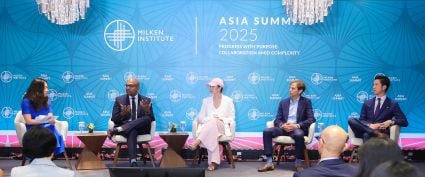
The 12th annual Milken Institute Asia Summit in Singapore convened global leaders transforming business, finance, government, health care, technology, and philanthropy to discuss critical topics of...





 IM