In This Issue
Play Back Milken Institute Asia Summit Health Sessions
Announcements
Program Highlights
Latest Reports
Learn from Milken Institute Health Experts
Upcoming Milken Institute Events
The 13th annual Milken Institute Asia Summit in Singapore brought together a global community of leaders to address the defining economic, geopolitical, demographic, and environmental challenges facing Asia and the world. Health programming—the Future of Health in Asia—at the event included six public sessions, all available to view on demand.
The Future of Aging and Longevity
Effective this fall, the Milken Institute Future of Aging is now the Milken Institute Future of Aging and Longevity. This rebrand reflects the evolution of the field and the emergence of longevity as a central issue that spans generations. While the program remains rooted in the aging field, alongside colleagues in aging services, advocacy organizations, and gerontology, the name change illustrates the new realities of aging.
To mark this milestone, the Future of Aging and Longevity brought together more than 50 leaders from across disciplines and released a collection of their essays, interviews, and expert commentary on the pressing generational issues of our time. This collection is brought to life in our new publication: The Future of Aging and Longevity: A Decade of Progress, A Decade to Act.
Milken Institute Women’s Health Network Expands Steering Committee to Drive Women’s Health Forward
The Milken Institute’s Women’s Health Network announced its 2026 Steering Committee, a multisector group of new and returning leaders who will guide the Network’s strategy and priorities for the year ahead. Members represent academia, research, advocacy, business, finance, health systems, pharma and life sciences, and technology. Together, they will help turn cross- sector collaboration into collective action to improve the health and well-being of all women. Learn more in this news release.
2026 Steering Committee Members include (* indicates new member):
- Monica M. Bertagnolli, MD, president, National Academy of Medicine*
- Nancy Brown, chief executive officer, American Heart Association
- Stephanie S. Faubion, MD, medical director, The Menopause Society*
- Juan Camilo Arjona Ferreira, MD, head of research and development and chief medical officer, Organon
- Janet Foutty, former chief executive officer, Deloitte; board director and consultant, Technology and Women’s Health Ventures; senior advisor, Women's Health Access Matters
- Ruth Gimeno, PhD, group vice president for diabetes and metabolic research, Eli Lilly and Company*
- Jyoti Gupta, PhD, chief executive officer of Breast & Skeletal Health Solutions, Hologic
- Shane Jacobson, chief executive officer, American Cancer Society
- Sabrina Martucci Johnson, president and chief executive officer, Daré Bioscience
- Ponda Motsepe-Ditshego, MD, vice president and head, Inclusive Global Health and Impact, Amgen; member, Amgen Foundation Board of Directors*
- Sara Rico, PharmD, AI transformation business lead, Microsoft
- Stacey E. Rosen, MD, executive director, Katz Institute for Women’s Health, Northwell Health; volunteer president, 2025–2026, American Heart Association
- Randi Seigel, JD, partner, Manatt, Phelps & Phillips LLP
- Trish Stroman, managing director and senior partner, Boston Consulting Group
- Kalahn Taylor-Clark, PhD, vice president and head of social impact and sustainability, Merck
Employer Action Exchange
Anchored in research highlighting emerging and escalating risks, with tangible actions for employers, the Employer Action Exchange (EAE) delivers customized research, thought leadership, projects, and a framework centered on four interconnected levers: organizational culture, benefits, community and business investments, and industry and sector standards that challenge the status quo.
EAE briefs and companion pieces are published year-round and provide timely, sought-after, evidence-based resources and approaches that advance employer priorities. This summer, in addition to publishing two briefs— Employer Priorities: Advancing Organizational and Employee Health in June and A New Era: Cross-Industry Executive Perspectives on Building Resilience in August—the EAE published a LinkedIn article series in July highlighting early findings from a two-year research project in partnership with The Hartford. A culmination of insights and actions from the project will be released as a brief at the Future of Health Summit in November.
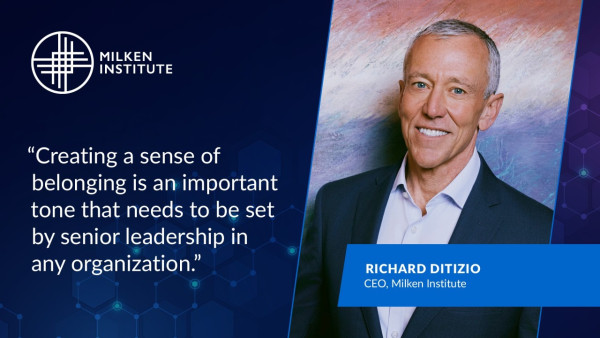
Milken Institute CEO Richard Ditizio was interviewed as part of the EAE’s Executive Insights series. This curated interview series highlights the work of executives in a wide range of C-suite roles, with new interviews published approximately twice a month. The insights and actions captured in these interviews are applicable across industries, sectors, and organizational sizes. Follow Milken Institute Health LinkedIn for upcoming EAE publications.
Strengthening US Competitiveness in Clinical Trials
Our most recent report, Enabling Access to Clinical Research: An Action Plan for Policy and Practice Change, outlines the adjustments needed across the clinical research ecosystem to make trials more patient-centered and embedded in care. This approach can help the United States run trials faster, reach more patient populations, and remain a premier destination for clinical research.
However, removing barriers is not enough without shoring up capacity: a broader network of trial- ready sites, trained clinicians and research professionals, interoperable data and technology systems, and infrastructure that can be sustained between individual studies rather than rebuilt each time. This capacity is what will allow the United States to compete for the trials of the future. These insights informed our broader Future of US Biomedical Research and Innovation Initiative, launched in 2025, which calls for federal-level coordination and a national clinical trials agenda as part of a national life sciences strategy.
To complement these efforts, our recent brief, Imperatives for United States Clinical Research Leadership and Coordination, builds a case for stronger federal leadership to safeguard US competitiveness, and, specifically, the opportunity for the federal government to identify areas where alignment and coordination are possible while creating a plan to sustain our highest national priorities in strengthening US clinical research while maintaining US global leadership in the field.
Feeding Change Hosts Inaugural Food Policy Plate
In July, Feeding Change hosted the first Food Policy Plate, an invitation-only food policy speaker series held over breakfast and coffee at the Milken Center for Advancing the American Dream. This series offers food and health experts the opportunity to meet and network across sectors, engage in targeted discussion, and collaborate to advance public- and private-sector solutions for food-system transformation.
Celebrating America’s Patient Advocates: Advancing the Next Era of Innovation and Access
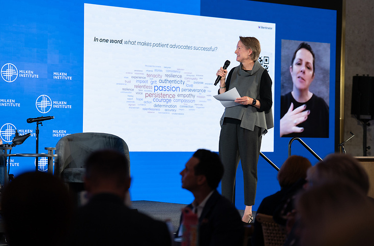
In October, FasterCures hosted a Patient Advocacy Forum, presented by Sanofi, at the Milken Center for Advancing the American Dream in Washington, DC. More than 200 advocates from rare- and common-disease communities, health system experts, and innovators joined us for panels and fireside conversations on closing the gap between scientific breakthroughs and patient access, ensuring patient perspectives shape AI and health data, speeding up clinical trials, and reimagining the role of advocacy organizations in a complex system. A written summary of the event is forthcoming.
Select Thought Leadership
Select External Speaking Engagements
- Kristin Schneeman, senior director, FasterCures, spoke about changes in research funding and drug development at the Food and Drug Law Institute’s Essentials of Working with US Food and Drug Administration for Patient Organizations webinar.
- Amanda Wagner Gee, associate director, FasterCures, presented at the 2026 National Institute of Neurological Disorders and Stroke Nonprofit Forum and a National Academies workshop on Enabling Networks of Research Infrastructure for Community Health through Clinical Trials’ work to advance community-based research.
- Sarah Wells Kocsis, senior director, Public Health, spoke at the Health Revolution Summit in Miami, FL, about GLP-1s, one of the biggest conversations in health and business right now.
- Athena Rae Roesler, director, Public Health, spoke on a panel at the National Association of Chain Drug Stores Total Store Expo about getting the most from pharmacist care to improve GLP-1 outcomes for patients.
- Clark spoke about early detection and patient advocacy at the Breast Cancer Early Detection Coalition's Capitol Hill Day in Washington, DC.
- Esther Krofah, executive vice president, Milken Institute Health, spoke about how new technologies, data insights, and innovative approaches are improving women’s health at the Constellation Forum in New York, NY.
- Anna Lin-Schweitzer, associate director, Feeding Change, moderated four roundtables focused on Food Is Medicine at the Rural Health Transformation Summit in Washington, DC.
- Holly Freishtat, senior director, Feeding Change, moderated a conversation at Strengthening Nutrition and Healthy Aging Infrastructure for Rural Older Adults at the Aspen Institute in Washington, DC.
Select Media Mentions
- Business Insider published “The Modern American Retirement Is Online,” featuring insights from Diane Ty, managing director, Future of Aging and Longevity. The article explores how older Americans are using AI to manage their health, start businesses, and stay engaged. Ty provides structural context on caregiving: “We’ve got 63 million family caregivers, 70% of them in paid jobs, and we’re very familiar with childcare, but elder care is not well understood. That’s what’s breaking the backs of so many workers right now.”
- Positive Aging Community podcast featured Lauren Dunning, senior director, Future of Aging and Longevity, in the episode “The Future of Connected Care: Enabling Healthy Longevity and Aging at Home.”
- Aging in America News published “Forever Young,” featuring insights from Ty on the uneven distribution of longevity: “Who gets to age well follows the same pattern and has the same structural barriers that we see elsewhere.”
- Stanford Center on Longevity published “Rebuilding the On-Ramp to Adulthood,” featuring Dawn Carpenter, director, Future of Aging and Longevity.
- Progressive Grocer published “Discussing the ‘New Gold Standard’ of Food at Retail,” covering a Nourishing Change Conference panel in Des Moines, IA, featuring Freishtat. She framed retail as a key part of the health ecosystem: “The role of the retailer right now is sitting at this moment in time where it’s easier for us to go to a grocery store to get health right now than to get to the doctor’s office.”
- Atoka County Times published “National Food Is Medicine Day: How Oklahoma Is Turning Produce Prescriptions into Permanent Care,” featuring Freishtat of Feeding Change.
- KTAL-TV (Shreveport, LA) – NBC 6 News Today featured Krofah, discussing US competitiveness in biotechnology and drug development. Krofah highlighted the value of everyday Americans participating in clinical trials, which can help lead to “a treatment and a cure that either they can benefit from, a family member can benefit from, or someone they may not even know well into the future.”
- Employee Benefit News published “3 Ways Women Are Still Struggling in the Workplace, and What Benefits Could Help,” featuring Sabrina Spitaletta, senior director, EAE. Building on the EAE report about employers investing in women, the article makes the case that employers have both a moral and financial imperative to address gaps in health-care access, benefits navigation, and professional development. “Employers can’t remove all of the workplace barriers, but they could help people work through it better and come out stronger,” Spitaletta noted.
- Today’s Clinical Lab covered the Institute’s Advancing Blood-Based Biomarkers for Alzheimer’s and Cognitive Care report and its call for wider adoption of blood biomarker testing. In Aging in America News and The Dark Report, Michael Brown, director, Future of Aging and Longevity, pointed to payer coverage as the clearest lag between scientific progress and health-system readiness, noting that coverage for the tests remains fragmented across regional Medicare contractors. “Part of what we’re pushing payers to do is stop tying coverage decisions strictly to anti-amyloid drug eligibility and instead recognize the other value these tests deliver: faster diagnosis, avoided unnecessary testing, and better- informed care decisions,” Brown told Aging in America News. In a STAT News column, “Dementia Should be a Campaign Issue—Not an Insult,” Brown argues, “Dementia is truly a bipartisan issue that affects everyone,” and addresses two persistent misconceptions: that dementia is a normal part of aging, and that it is the same as Alzheimer’s.
- The Women’s Health Network’s Coverage and Reimbursement Roadmap for Women’s Health Innovation drew wide media attention. BioIntel, Femtech Insider, Formidable, and MedCity News covered the report’s findings on the coverage and reimbursement barriers facing women’s health start-ups. FutureFemHealth highlighted the report’s recommendation to decide between self-pay and payer coverage well before a product is ready for market, and its warning that securing a new billing code can take around three years. “I think one takeaway from the report is to make sure when you’re developing your innovation to think about reimbursement earlier than you think you should,” Patterson told MedCity News.
- Worth published “Where Women’s Health Breaks" and “Women’s Health Takes Center Stage,” featuring insights from Jenica Patterson, senior director, Women’s Health Network, and Caitlin MacLean, managing director, Catalytic Capital. The pieces position the Network as the Institute’s response to what Patterson calls “the commercial valley of death,” a funding gap where later-stage capital has stalled, and highlight its two funding initiatives, five working groups, and new digital platform.
- CNA and The Straits Times covered remarks from Biden and Kung on the future of women’s health, spotlighting the Institute’s Women’s Health Network. The coverage, including a CNA video segment, focused on what the US can learn from Singapore’s emphasis on lifelong preventive care and on closing the gap in the years women spend in ill health.