

Webinar

SHARE
SHARE
The third installment of the Vital Voices webinar series explored how patient organizations can navigate and inform state-level coverage and payment structures to improve treatment access. State Medicaid programs play a pivotal role in determining whether patients can receive the therapies they need, yet their decision-making processes can be complex and vary from state to state. This webinar featured perspectives from state agencies and patient organization leaders to equip advocates with practical strategies to engage with Medicaid, Prescription Drug Affordability Boards (PDABs), and other state decision-makers. Speakers highlighted how structured and well-prepared patient insights can inform state coverage policies, strengthen coverage and affordability determinations, and ultimately help ensure that access structures reflect the lived experiences of patients and families.
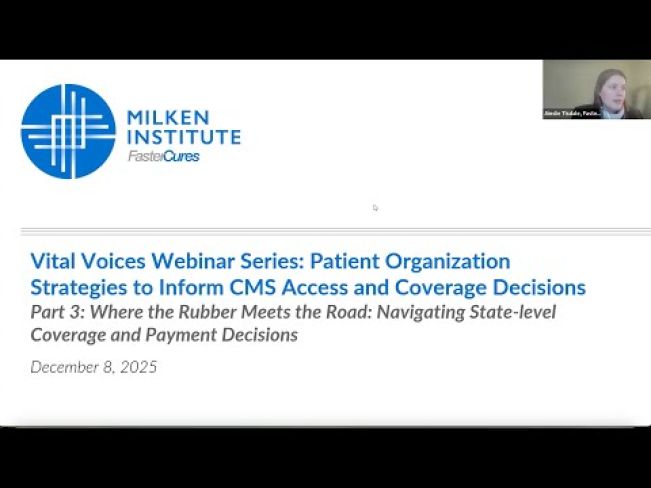
Speakers:
Amy Aikins
Former Director, Patient Access, Little Hercules Foundation
John E. Matta, PharmD, MBA
Interim Director of Pharmacy and Ancillary Services, Pharmacy Manager, Operations and PBA Services, NC Medicaid, Division of Health Benefits, NC Department of Health and Human Services
Andrew York, JD, PharmD
Executive Director, Maryland Prescription Drug Affordability Board (PDAB)
Key Webinar Takeaways
- More formal pathways for patient input are emerging. States are establishing or expanding Beneficiary Advisory Councils (BACs), Pharmacy & Therapeutics (P&T) Committees, Drug Utilization Review Committees, and Medical Care Advisory Committees (MACs), creating new pathways for Medicaid beneficiaries, caregivers, and advocates to inform access decisions.
- Patient experience insights are essential, and processes vary across states. Expectations and engagement structures differ, making it challenging and resource-intensive for patient organizations to understand the coverage processes and opportunities to engage in each state.
- Capacity-building resources are growing. Several organizations, including the Little Hercules Foundation’s Rare Access & Coverage Education (RACE) Training Program, offer training and materials to support patients and advocates preparing to serve in advisory roles and engage with Medicaid.
- Support is needed to make participation meaningful. Questions regarding compensation, support services, and time demands emerged as critical factors in ensuring patients can engage effectively and sustainably.
- Formal mechanisms for submitting input exist, and more are being developed. States shared examples for gathering patient input, including open public meetings, 30-day public comment periods, Maryland PDAB’s patient submission forms, and North Carolina Medicaid’s public comment processes for preferred drug list (PDL) decisions and clinical criteria. PDABs are a relatively new state entity that conduct drug cost reviews, assess affordability challenges, set upper payment limits on what states will pay for certain drugs, and may recommend policies to improve drug affordability and access.
Strategies discussed:
- Prepare patients for advisory participation. Offer coaching, training, and readiness support to help individuals contribute meaningfully to BACs, MACs, and other committees (e.g., Little Hercules RACE program and forthcoming resources from the EveryLife Foundation).
- Build relationships early. Patient organizations benefit from establishing ongoing communication with payers and advisory bodies through BACs/MACs and PDAB processes.
- Standardize patient experience input. Tools such as common forms, templates, or submission portals help ensure that patient insights are consistent, usable, and aligned with decision-maker needs.
- Share and adapt resources across patient communities. Advocacy organizations can strengthen their collective impact by exchanging materials and aligning expectations and best practices for engaging in pricing and coverage deliberations.
- Encourage payer-side engagement. Connecting Medicaid programs and P&T committees with trained patient and caregiver representatives can support more informed utilization management and drug coverage decisions.
Webinar Resources Mentioned
- Webinar Slides
- Little Hercules RACE Training Program
- Maryland PDAB patient drug submission portal
- EveryLife Foundation Policy Resources
- FasterCures TRAIN
- LeadersLink program (FasterCures)
- Vital Voices Program
This webinar was made available to patient organizations that participate in The Research Acceleration and Innovation Network (TRAIN). TRAIN is a network of more than 180 foundations interested in taking a strategic and entrepreneurial approach to funding medical research. TRAIN convenes forward-thinking groups to learn from each other and share their novel solutions with the rest of the medical research system. FasterCures accepts new organizations to TRAIN on an ongoing basis. There is no fee for the application or for membership. To learn more and apply, visit the TRAIN application. Please contact [email protected] for more information about TRAIN.
SHARE
Related Content
-

Vital Voices Webinar Series Part 2: Patient Organization Strategies to Inform CMS Access and Coverage Decisions
For some patient organizations, engaging with CMS can feel unattainable due to limited resources and expertise. Participating in coalitions can help overcome these challenges by amplifying collective patient voices, aligning priorities, and...View Webinar -
Vital Voices Webinar Series Part 1: Patient Organization Strategies to Inform CMS Access and Coverage Decisions
For some patient organizations, engaging with CMS can feel unattainable due to limited resources and expertise. Participating in coalitions can help overcome these challenges by amplifying collective patient voices, aligning priorities, and...View Webinar -

Framing the Value of Patient Engagement for Medtech Product Developers
This report aims to support more robust patient engagement (PE) by device, diagnostic, and digital health—i.e., medtech—product developers.Read Report -
Defining and Demonstrating the Value of Patient Engagement in Medtech Research and Product Development
In 2022, FasterCures published a report titled The Current Landscape of the Science of Patient Input, which examined the progress of patient engagement (PE) in biomedical research and identified ways to overcome ongoing challenges. Building...Read Report
 AS
AS
-

The Current Landscape of the Science of Patient Input
In the last decade, FasterCures and many stakeholders across the biomedical research ecosystem have driven initiatives to ensure that patients’ perspectives and input are appropriately represented across the product-development continuum...Read Report
HO
-

Imperatives for United States Clinical Research Leadership and Coordination
The US spends nearly 18 percent of its GDP on health care, yet life expectancy has barely improved and outcomes trail those of peer nations.Read Report



-

Cancer 2035: A Roadmap for the Future
In February 2026, leaders from across science, medicine, policy, technology, finance, and philanthropy gathered in Washington, DC, to discuss how the cancer model of research and innovation can evolve for the next eraRead Report -
Request for Information on Next-Generation Cures Bill
The Honorable Diana DeGette US House of Representatives Washington, DC 20515 The Honorable Larry Bucshon, MD US House of Representatives Washington, DC 20515 Re: Request for Information on Next-Generation Cures Bill Dear Representatives...Read LetterImage
Esther Krofah
Executive Vice President, Milken Institute HealthEsther Krofah is the executive vice president of Health at the Milken Institute, leading FasterCures, Public Health, the Future of Aging, and Feeding Change. A recognized expert in health policy, biomedical innovation, and clinical research, Krofah has extensive experience shaping health initiatives that unite diverse stakeholders, foster collaboration, and motivate action toward shared goals.