

In This Edition:
Spotlight: New Publications
Events Recap
Thought Leadership
Select Project Updates
From Our Advisory Board
Spotlight: New Publications
Our newest publication, Digital Technology Bundles: A Testing and Validation Blueprint for Fall Prevention, was released last week, and we published two reports during the 2025 Future of Health Summit: Longevity Ready: A Systems Approach to Aging Well at Home and The Longevity Equation: Integrating Healthspan and Wealthspan.
Digital Technology Bundles: A Testing and Validation Blueprint for Fall Prevention
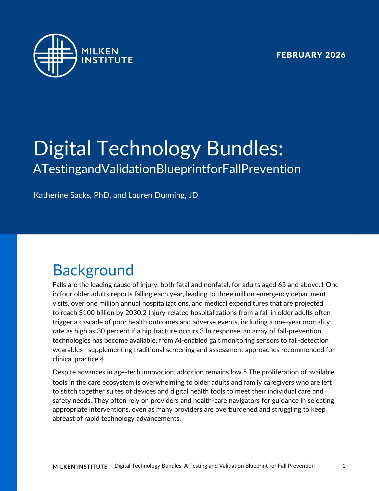
Digital Technology Bundles: A Testing and Validation Blueprint for Fall Prevention offers a new framework for classifying, bundling, and evaluating digital fall-prevention technologies more effectively. Supported by Samsung, the report highlights the need to move beyond fragmented point solutions by testing combinations of technologies through rigorous yet pragmatic trial designs, particularly in senior living settings. The authors, Associate Director Katherine Sacks and Senior Director Lauren Dunning, offer a roadmap for building evidence-based technology bundles that can improve user experience and outcomes for older adults aging at home or in care facilities.
Longevity Ready: A Systems Approach to Aging Well at Home
Longevity Ready: A Systems Approach to Aging Well at Home outlines strategic actions to help people across generations prepare for healthier, longer lives. Authored by Dunning and Jennifer Rossano and supported by Manulife, the report highlights key dimensions of planning for aging in place and offers a systems-based approach to mobilizing support. Read the full report to find implementation strategies that increase awareness and specific action steps for key stakeholders.
The Longevity Equation: How Healthspan and Wealthspan Intersect
Healthy longevity in the US remains out of reach for far too many people. Two of the most powerful determinants—physical health and financial well-being—are deeply interconnected yet rarely addressed together. The Longevity Equation: How Healthspan and Wealthspan Intersect offers a new way to understand and close this gap.
Authored by Director Dawn Carpenter, DLS, inspired by TIAA Institute, and supported by Synchrony and Hoplon Capital LLC, the report introduces the Longevity Equation (H × W) × T^β, a practical framework illustrating how health (H), wealth (W), and technology (T) interact over the life course to shape longevity outcomes. Read the full report to learn how the health care and financial services sectors can leverage their respective strengths to improve longevity outcomes across the lifespan.
Events Recap
2025 Milken Institute Future of Health Summit
The 2025 Milken Institute Future of Health Summit centered on the theme In Service of Better Health. The two-day event featured more than 200 speakers and 1,400 participants from across the health, business, philanthropy, government, and tech sectors to advance solutions and practices across several focus areas.
The Milken Institute Future of Aging curated two public and two private sessions, including the convening of the Milken Institute Future of Aging Advisory Board. Details of these engagements are highlighted below.
Redefining Care
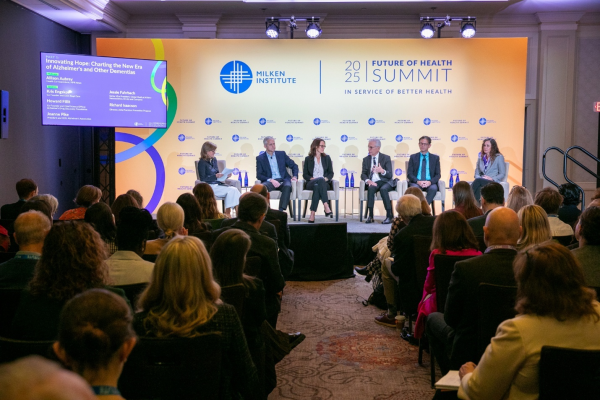
Part 1: Innovating Hope: Charting the New Era of Alzheimer's and Other Dementias
The tone surrounding an Alzheimer’s disease diagnosis is moving from a hushed whisper to a rising chorus of hope. Disease-modifying therapies and novel blood tests integrated into clinical practice are ushering in a new era of care, facilitating more open discussion around cognition than ever before. A wave of digital technologies and AI applied to speech, sleep, and everyday activities will provide new paths to early detection, and a pipeline of drug therapies holds promise. Innovative payment models are helping to promulgate comprehensive dementia-care programs. It’s time to demonstrate impact and effectiveness, so that the 7.2 million Americans now living with Alzheimer’s are guided not by fear, but by hope.
Part 2: A Conversation with CMS Director of Medicare Chris Klomp
CMS Director of Medicare Chris Klomp joined for a brief conversation on the role of Medicare in America and how preventive lifestyles and early medical interventions can contribute to healthier longevity when Americans reach age 65.
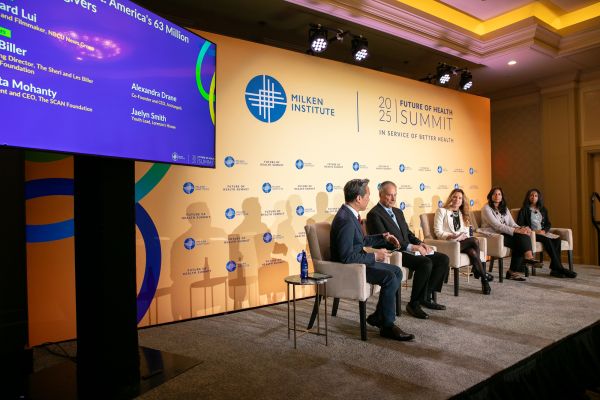
The Breaking Point: America’s 63 Million Family Caregivers
Across America, unpaid caregivers are quietly unraveling—emptying retirement accounts, skipping medical appointments, and crying behind closed doors between meetings. They include the working mother caring for a father with dementia, the executive who has already spent $50,000 on care and yet still cannot afford the support his wife needs after a devastating stroke, and the nine-year-old helping his wheelchair-bound father after school.
These 63 million Americans—including 5.4 million children under 18—face financial, physical, and emotional strain without the support necessary to protect their health and well-being. With rising care costs, an aging population, and a national mental health crisis, the urgency has never been greater. This panel confronted the reality that America’s care system is broken, explored caregiving at every life stage, highlighted the consequences of neglecting caregivers, and identified bold actions that health systems, communities, and policymakers can take to build a future where caregivers are supported, seen, and protected.
Democratizing Longevity: Harnessing the Economic Power of Health-Care Institutions
The life-expectancy gap separating the healthiest and wealthiest American communities from their poorest and sickest counterparts is projected to reach an unprecedented 35 years by 2025. This panel examined the structural inequalities that undermine health and longevity and explored the role of nonprofit teaching hospitals as "anchor institutions" within their communities.
A growing number of these institutions have begun to leverage their extensive resources strategically—lending expertise, capital, and influence to make a meaningful impact on their communities' health. By adopting the “anchor strategy,” these organizations prioritize local hiring, investment in local businesses, and deep engagement with the communities they serve to build community wealth that translates into improved health outcomes and ultimately healthy longevity.
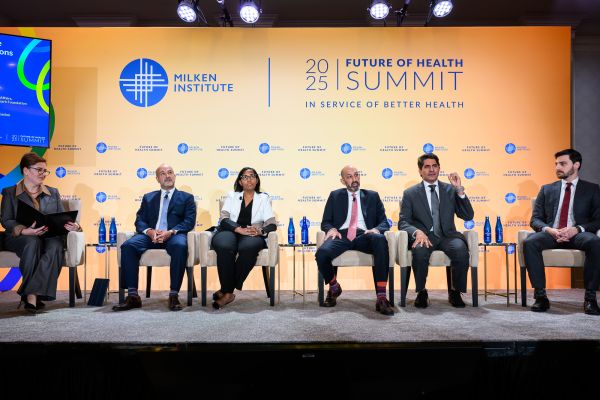
The Longevity Equation: Integrating Healthspan and Wealthspan
As Americans live longer, the challenge is no longer just adding years to life, but adding quality, health, and financial security to those years. This panel explored the converging roles of health care, credit, workplace benefits, and financial planning in supporting well-being across an extended lifespan.
With rising health-care costs and uneven access to financial tools, people are often unprepared for the economic realities of aging. This discussion called on leaders across sectors to examine innovative strategies—from proactive wellness financing to inclusive credit and benefit models—that can close the gap between what people need and what current systems deliver.
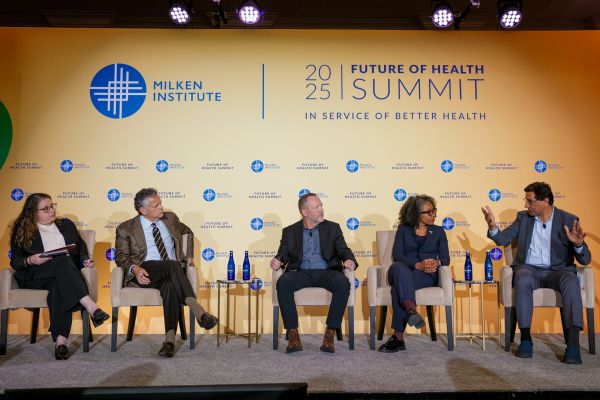
Future of Aging Advisory Board
The Milken Institute Future of Aging Advisory Board brings together influential leaders in a premier forum to accelerate innovations in aging, scale promising solutions, and champion individual, institutional, and societal preparedness for longer lifespans. This conversation focused on the current policy landscape, effective communication strategies in 2025, and opportunities to build momentum to support longer, healthier lives.
2026 Milken Institute South Florida Dialogues
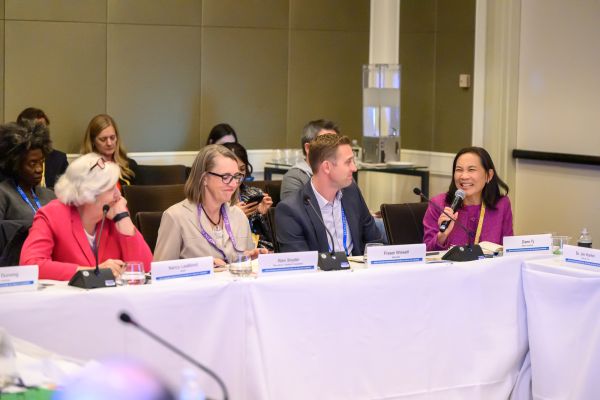
Managing Director Diane Ty moderated a panel titled “Inside Out: The Science of Living Longer and Thinking Better” with leaders at the forefront of evidence-based practices and interventions to increase healthspan at the 2026 Milken Institute South Florida Dialogues.
Thought Leadership
This section showcases articles, media highlights, and more, featuring Milken Institute Future of Aging leaders as speakers, authors, or expert interviewees.
Power of Ideas Essays
The Power of Ideas is a thought-provoking essay collection that invites select speakers to respond to the conference’s theme. This year, Future of Aging speakers contributed nine out of the 19 essays for the series!
- Joseph Betancourt, president of the Commonwealth Fund: “An Icon Showed Us the Way: Food, Medicine, and a Healthy America”
- Kris Engskov, cofounder and CEO, Rippl Care: “We Know How to Fix Dementia Care—Now We Need to Commit to Doing It”
- Omar Lateef, president and CEO, Rush University Medical Center: “Driving Change Through Health Reminders and Incentives to Improve Life Expectancy”
- Alberto Casellas, executive vice president and CEO, Health Wellness, Synchrony: “Making Longevity Achievable—and Affordable”
- Sarita Mohanty, president and CEO, The SCAN Foundation: “Honoring the Patient Voice: Partnering with Older Adults to Improve Health”
- Bobby Mukkamala, president, American Medical Association: “Effective Partnerships Will Improve Public Health and Restore Trust”
- Laura Steele, senior vice president, US Neuroscience Business Unit, Eli Lilly and Company: “How Multisector Collaboration Can Meet and Anticipate Alzheimer’s Advancements”
- Howard Fillit, cofounder and Chief Science Officer, Alzheimer’s Drug Discovery Foundation: “Harnessing the Alzheimer’s Ecosystem to Accelerate Progress”
- Alexandra Drane, cofounder and CEO, Archangels: “The Future of Health Innovation: Public-Private Partnerships”
Articles and Papers
November 11: Our second Stories from the Field: Caregiving Champions article, a series spotlighting companies that support employees with caregiving responsibilities, featured Stacy Dillow, PhD, executive vice president and chief people officer at Hewlett-Packard Enterprise (HPE). She showcased HPE’s innovative caregiving programs and how the company leverages digital tools to support caregiving employees. For strategies, see our 2025 report, Supporting Family Caregiving: How Employers Can Lead.
November 19: Carpenter authored a LinkedIn article titled “The Ethics Behind the Longevity Equation.” The article provides context and rationale for the Future of Aging report, The Longevity Equation: Integrating Healthspan and Wealthspan.
January 21: Director Michael Brown participated in the Dementia Care Navigation Roundtable with the Alzheimer’s Association. Brown is a contributing author to the roundtable’s new white paper “Building a Business Case for a Dementia Care Program,” which provides practical guidance for clinical and financial leaders building or expanding dementia care programs. He also helped develop a Dementia Care Financial Modeling Tool to provide more insight into how to invest and expand these programs.
External Events
October 7: Ty spoke on a panel at OneAmerica Financial’s Long-Term Care Summit in Indianapolis, IN, featuring principals from Bradley Cooper’s Caregiving documentary.
October 30: Associate Director Priyanka Shah spoke at the Supporting Caregivers in the Workplace Summit with the SHRM Foundation and the Elizabeth Dole Foundation. The closed-door event featured panels on policy solutions, organizational best practices, and the financial implications of caregiving, as well as fireside chats with C-suite executives and thought leaders.
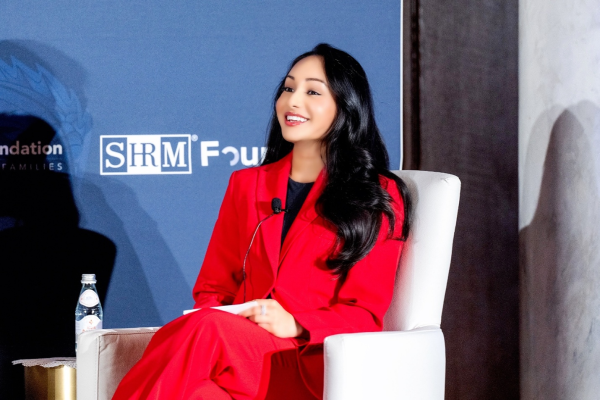
November 12: Shah spoke at a virtual event with U.S. News & World Report titled “Beyond Benefits: Building a Workplace That Works for Caregiving Employees.” This virtual event examined real-world examples of innovative employer approaches to supporting caregivers and explored them alongside the latest data and insights into employer benefits.
January 30: Ty spoke on a panel, "Tackling Chronic Disease: Achieving Real Impact,” at the 2026 Stanford Medicine Leadership Retreat in Redwood City, CA. The event gathered the senior-most leaders from across the enterprise to discuss organizational priorities and the opportunities and challenges ahead.
Media Highlights
October 15: Carpenter was quoted in an article in PlanSponsor titled “How Client Health Risks Become Adviser Financial Risks.” The article examines how cognitive decline and chronic illness in aging clients can leave their financial advisors at risk.
November 24: Ty was quoted in a Kiplinger article titled “The Surprising Way to Reduce Your Dementia Risk.” The article discusses hearing loss as an addressable risk factor for dementia.
December 1: Carpenter’s report, The Longevity Equation, was quoted in an article from McKnight’s Senior Living titled “As Longevity Increases, Health Outcomes, Financial Security Can’t Keep Pace, Report Says.”
December 3: Ty and Shah were quoted in a USA Today article titled “These People Know How to Fix the Caregiving Crisis. Is It Doable?” The article examines the growing strain on America’s family caregivers and evaluates whether the country is on track to provide respite care, mental health support, and paid family caregiver programs.
December 27: Carpenter was quoted in an article from Business Insider titled “From Social Security to Jobs: Older Americans were anxious this year.” The article focuses on how many adults are delaying retirement or continuing to work out of necessity, highlighting broader systemic pressures affecting aging populations.
January 15: Ty was quoted in Flow Space’s article “The Longevity Paradox,” discussing the phenomenon in which women outlive men on average but may face a higher burden of chronic illness and poorer health in later life.
January 16: Dunning was quoted in U.S. News & World Report in the article “How to Pay for Senior Living: A 2026 Budget Comparison,” a piece that outlines how senior living costs vary widely by location and level of care, and emphasizes the importance of early planning, inflation awareness, and understanding pricing structures, such as tiered or à la carte care models.
Podcast Interviews
December 5: Carpenter appeared on the Risking Old Age in America podcast to discuss the concept of financial longevity. The episode, titled “Ensuring Financial Longevity with Dr. Dawn Carpenter,” covered topics including defining financial longevity, financial planning for college and retirement, aging and long-term care, as well as the role of the Milken Institute's programmatic work in this area, and policy recommendations.
Select Project Updates
Connected Care at Home
Along with the release of our newest report, Longevity Ready: A Systems-Based Approach to Aging Well at Home, Manulife John Hancock, in partnership with MIT AgeLab, has developed the Longevity Preparedness Index, a tool measuring eight domains essential to living well in later life: Care, Community, Daily Activities, Finance, Health, Home, Life Transitions, and Social Connection. Beyond its use as a tool in and of itself, we believe the index can be a catalyst for a cohesive movement across sectors, prompting collaboration, coordination, and action to support healthier, better-prepared aging populations.
Manulife also launched its Global Longevity Institute, committing $350 million by 2030 to accelerate progress on lifelong health and financial resilience.
Alliance to Improve Dementia Care
The Alliance to Improve Dementia Care continues to convene leaders across sectors to connect with breakthroughs, innovations, and programs advancing dementia care. In 2025, the Alliance held 11 all-member meetings, attracting 200 unique individuals from 130 organizations to learn and discuss the latest news in early detection, diagnosis, caregiving, and healthy equity. Three new members joined the Steering Committee: Novo Nordisk, CaringKind, and Gates Ventures.
If you're interested in learning more about the Alliance and joining our growing network, please reach out to Michael Brown at [email protected].
From Our Alliance Steering Committee
- AARP invites nonprofit organizations and governments to apply for the 2026 Community Challenge Grant. The AARP Community Challenge grants fund quick-action projects that help communities become more livable by improving public places, transportation, housing, digital connections, and more. Applications close March 4, 2026.
- The Alzheimer’s Association earned a joint accreditation status to provide interprofessional continuing education. The credential will allow the association to train health teams through a single accreditation process. The Alzheimer’s Association also awarded a $1 million grant to Muna Therapeutics to advance the clinical development of the novel oral TREM2 Agonist MNA-001 for Alzheimer’s.
- The Alzheimer’s Drug Discover Foundation awarded a $250k grant to Circular Genomics to advance a first-in-class blood-based biomarker for early detection of Alzheimer’s.
- Biogen and Eisai announced today that the Biologics License Application for LEQEMBI has been accepted by the National Medical Products Administration in China. Eisai presented long-term 10-year benefit, estimates for continued LEQEMBI treatment, suggesting time savings of 8.3 years for the low-amyloid group in delaying progression from MCI due to AD to moderate AD.
- CaringKind announced a strategic affiliate partnership with Alzheimer’s Disease Resource Center to expand dementia care throughout New York.
- Eli Lilly presented early Phase 3 data for TRAILRUNNER ALZ-1, studying remternetug subcutaneous self-injectable for early Alzheimer's. Lilly also presented additional follow-up analysis of the TRAILRUNNER ALZ-2 long-term extension study and found that, after 12 months of Kisunla, a subgroup showed sustained cognitive and functional benefits 2 years after treatment ended. This subgroup had a twenty-seven percent reduced risk of advancing to the next stage compared to those who initiated the long-term extension.
- Gates Ventures and ADDI announced the top 5 teams selected to compete for the $1M Alzheimer's Insights AI Prize at AD/PD in March.
- John A Hartford Foundation approves five new Grant Initiatives for a total of $10.5M
- Novo Nordisk narrowly missed Phase 3 semaglutide primary endpoints on CDR-SB while showing some movement on biomarkers in early-stage Alzheimer's
- Roche shared early insights from the ongoing Phase I/II Brainshuttle AD study, finding that 92 percent of patients treated with trontinemab achieved a clearing of amyloid below 24-centiloids.
- West Health, in partnership with Gallup, unveiled new state rankings of Americans' health-care experiences.
From Our Advisory Board
Dan Buettner, founder of Blue Zones LLC, participated in National Geographic’s Ask an Expert Anything video series. In the video, Buettner addressed questions ranging from what surprised him most in his longevity research to how America’s cultural norms can make it harder to adopt a Blue Zones lifestyle.
Alberto “Beto” Casellas, executive vice president and CEO, Health & Wellness, Synchrony, spoke on the “Longevity Equation: Integrating Healthspan and Wealthspan” panel at the 2025 Milken Institute Future of Health Summit.
Laura Carstensen, director of the Stanford Center on Longevity, was interviewed by Time Magazine in an article titled “The Best Years of Your Life Are Probably Still Ahead.” Carstensen discusses why aging should be something to look forward to rather than something we are taught to dread.
TheUniversity of Southern California Leonard Davis School of Gerontology, led by Dean Pinchas “Hassy” Cohen, announced a $6.5 million NIH grant, alongside Cedars-Sinai and UCLA, to establish an independent center for older Americans in Los Angeles. Cohen will serve as co-director of the center, which will focus on extending the healthspan of older adults and improving their quality of life.
Catherine Collinson, CEO and president of Transamerica Institute, published an updated annual edition of the Institute’s retirement survey. The new study, titled Retirement Realities: The Experience of Retirees 25th Annual Transamerica Retirement Survey, highlights aging and longevity-related challenges faced by today’s retirees and offers critical insights for strengthening retirement security for current and future generations
Joseph Coughlin, founder and director of the MIT AgeLab, authored an article for Forbes titled “Younger Boomers Are Driving On-Demand Living In Retirement,” examining how younger Baby Boomers are outpacing other generations in using on-demand lifestyle apps, such as DoorDash and Uber. Coughlin also joined WBUR’s podcast Here and Now to discuss what it will look like when individuals begin taking on caregiving responsibilities. He is featured in numerous articles and posts for the MIT AgeLab’s role in developing Manulife’s Longevity Preparedness Index.
Ken Dychtwald, founder and CEO of Age Wave, was interviewed by Kiplinger in “Why Turning 65 Isn't What It Used to Be, According to an Expert,” discussing the Peak 65 trend and why people turning 65 should plan for their lives to extend another 30 years.
Myechia Minter-Jordan, MD, CEO of AARP, spoke with Alison Aubrey at the 2025 Washington Post Global Women’s Summit. The conversation focused on our era of longevity, shed light on the greatest challenges and opportunities for women, and outlined the steps we can all take to put more good years of life within reach.
Teresa Ghilarducci, director of the Schwartz Center for Economic Policy Analysis at the New School, authored a Forbes article, “Security’s Payroll Tax Stops For The Rich—But Not For You,” and was interviewed by Yahoo! Finance in “This Retirement Expert Says the US is ‘Past the Point Where We Can Fix Social Security.’ What She Recommends Instead.”
Surya Kolluri, senior vice president and head of the TIAA Institute, appeared on Yahoo! Finance’s Decoding Retirement podcast on support for America’s unpaid caregivers. Kolluri also testified at the House Employment, Labor, and Pensions Subcommittee hearing on “Modernizing Retirement Policy for Today’s Workforce.”
Bob Kramer, cofounder and strategic advisor at National Investment Center, was quoted in Business Insider’s “Better than Boca,” discussing the future of aging communities and the importance of strong social connections for older adults.
Abby Levy, managing partner and cofounder at Primetime Partners, joined CNBC’s Fast Money to discuss investing in aging and longevity.
Becca Levy, professor of epidemiology at the Yale School of Public Health, was mentioned in an NPR article from WGLT, “Changing Your Perception on Aging Can Lead to Greater Well-Being, Psychologist Says,” highlighting her research on the impact of negative beliefs about aging on mental and physical health.
Sarita Mohanty, president and CEO of The SCAN Foundation, authored a Forbes article, “Medicare, Medicaid And the Older Americans Act At 60: Why Business Leaders Should Care,” making the business case for supporting and funding Medicare and Medicaid to mark the 60th anniversary of the Older Americans Act.
Jennifer Molinsky, director of the Housing and Aging Society Program at the Joint Center for Housing Studies of Harvard University, coauthored an article in SSM-Population Health,“Housing Distress and Subsequent Health and Well-Being Among Older Adults: An Outcome-Wide Longitudinal Approach,” examining links between housing distress and 35 indicators of physical, behavioral, and psychosocial health and well-being.
Eunice Lin Nichols, co-CEO of CoGenerate, participated in a panel for Wesleyan University’s Shasha Seminar for Human Concerns. The panel, titled “Building Community in Divided Times,” shared ideas for activating disparate communities through connecting across generations.
Hon Pak, senior vice president and head of the digital health team, Mobile eXperience, Samsung Electronics, authored an editorial, “Harnessing the Power of AI: A Sneak Peek into How Samsung is Turning Complexity to Comprehension,” in which he expressed his belief that AI will revolutionize the digital health industry and simplify the wellness journey for everyone.
Manulife John Hancock Retirement, led by CEO Wayne Park, launched the Longevity Preparedness Index, a groundbreaking tool that reveals insights and helps customers live longer, healthier lives. This first-of-a-kind tool reveals a bold new benchmark for US adults' readiness to live well in older age.
Penny Pennington, managing director at Edward Jones, joined the Tony Sirianni podcast episode, “Edward Jones Is Doubling Down on Partnership, Scale and Next-Gen Advice,” discussing investments that help employees grow and meet the changing needs of clients.
Andrew Scott, professor of economics at the London Business School, was quoted in an article titled “When You’re at the Top, It’s the Perfect Time to Step Back,” referencing his book The 100-Year Life and the cyclical reality of work, with alternating periods of work, learning, renewal, and reinvention.
The Eisner Foundation, led by CEO Trent Stamp, is serving as the US Country Lead for Global Intergenerational Week in April 2026, alongside Generations United.
Kai Walker, managing director of workplace benefits research and inclusion transformation at Bank of America, was quoted in PlanSponsor, “Benefits Continue as Major Factor in Employee Retention,” which focused on the results of the 2025 Bank of America Workplace Benefits Report.