Insights
Beyond COPs: Building the Road to Resilience





The conversation about climate and sustainability has shifted a great deal in the last few years, from what we need to do to achieve 2050 science-based targets and keep average warming below 1.5 degrees Celsius, to how we more rapidly adapt to a new world in an era of AI, fiscal stress, and geopolitical disruptions.
In short, increasing resilience to disruption in the next three to five years requires a rapid recalibration of both the use of public money and private investment mechanisms that lift up local economies and build critical infrastructure. While the 31st Conference of the Parties (COP) in Antalya, Turkey, and the G20 meetings are important, these government-led mechanisms alone are clearly insufficient for meeting the scale of the challenge.
The solution, however, is not to stop having annual UN and government gatherings. We need to build parallel deployment momentum and continuity between COPs through focused investor activity.
Since COP28, the Milken Institute has convened regionally diverse groups of asset owners, asset managers, and sector experts to better understand what it will take to accelerate the deployment of private capital in resilient infrastructure and natural systems and fund net- positive climate outcomes. Our work has focused on closing two gaps that stand in the way of this acceleration: the missing implementation and pricing mechanisms that are needed to attract and deploy capital at scale and the need to shift the public discourse to a resilience- based narrative.
To further guide this critical pivot, the Institute is today releasing The Acceleration Agenda: The Road to Resilience, which calls for building out the innovation infrastructure, sustained investor activity, and dominant new narrative to promote this shift.
The key elements of the new strategy:
Calls to treat climate change as an urgent moral and environmental crisis are not winning the argument in an era of multiple crises happening on land, at sea, and in space. Be it supply-chain shifts due to hot wars, demand for critical minerals to drive electrification, or fast-growing energy demand to feed AI, business as usual on “climate action” is changing.
Yet this doesn’t have to be a Bleak House scenario.
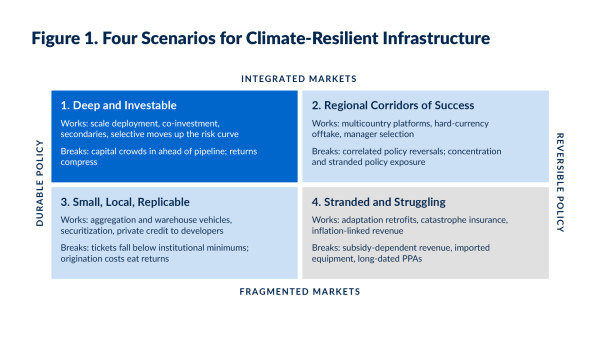
Looking ahead, we see four major scenarios developing to shift the scale of climate-positive investment over the next five years (Figure 1). We can stay stuck in the bottom-right box below (Stranded and Struggling) or move up and across to drive new deal flow by following the clear signals that the investment community is sending. Major investors are less interested these days in projects with a perfect net-zero score. Risk management and commercial returns for resilience and sustainability projects are what will move the dial.
The effective closure of the Strait of Hormuz for much of 2026 and surging AI energy demand are driving the localization of climate finance and changing investor appetites. Both institutional investors and local communities are now focused on delivering energy security and grid reliability, addressing physical and portfolio risks on their balance sheets. These are critical additional “signals” to follow to address climate change and drive community resilience.
To get there, we are offering a series of recommendations outlined in our Acceleration Agenda working paper released this week.
We’d love to hear from you. To learn more about our scenario work and future outcome- focused convenings, please email [email protected].



 MB