
In This Newsletter
Future of Finance
Digital Assets Market Structure Holding Pattern
Institutional Tokenization Gears Up
Future of Finance
This March, the Milken Institute hosted the inaugural Future of Finance 2026 at the Milken Center for Advancing the American Dream in Washington, DC, convening policymakers, investors, and innovators to examine how financial systems are evolving through technology, regulation, and new market infrastructure. Across the FinTech programming, the discussion centered on regulatory modernization, stablecoins, prediction markets, AI, and the next phase of financial innovation.
The event opened with “Modernizing Market Regulation: A Conversation with SEC Chairman Paul Atkins and CFTC Chairman Michael Selig,” moderated by Executive Vice President of Milken Institute Finance Michael Piwowar. The session focused on US market oversight in digital assets, regulatory harmonization, capital formation, and the growing relevance of products such as perpetuals and prediction markets.
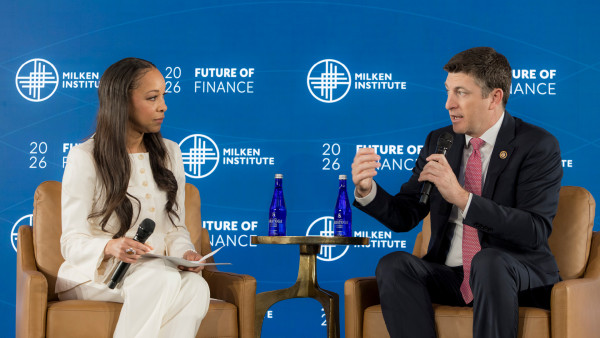
That discussion continued in “A Conversation with US House Financial Services Subcommittee on Digital Assets Chairman Bryan Steil,” moderated by Senior Director of FinTech Nicole Valentine, followed by “The Genius Effect: Stablecoins Take the Stage,” moderated by Daniel Gorfine and featuring Lauren Belive, Robin Cook, Michael Greenwald, Eugene Ludwig, and Caroline D. Pham. Together, the two sessions focused on the policy and market implications of the GENIUS Act, the expanding role of stablecoins as dollar-based payment infrastructure, and the push to integrate stablecoin policy, applications, and institutional adoption into the broader financial system.
The program highlighted new market structures in “Prediction Markets: New Players, New Rules,” moderated by Lydia Beyoud and featuring Keli Callaghan, JB Mackenzie, Sean Patrick Maloney, and Patrick McHenry. The Milken Institute framed the panel around a core question: whether prediction markets are becoming a legitimate part of the financial mainstream, a new mechanism for price discovery, or a repackaging of conventional betting. The discussion examined governance, market structure, and where these products may fit within the future financial ecosystem.
On the advanced technology track, “AI and the Future of Digital Transformation,” moderated by Valentine and featuring Jo Jagadish, Karen Kornbluh, Eric Mandl, Igor Tulchinsky, and Kip Wainscott, explored how AI is reshaping the way firms, investors, and governments operate, while raising new questions around infrastructure, workforce readiness, energy demand, and national security. The day closed with “FinTech Megatrends: Innovation, Inclusion, Infrastructure,” moderated by Associate Director Maxwell DeGregorio and featuring Wale Ayeni, Denise Leonhard, Nathan McCauley, and Jelena McWilliams. The session focused on the next wave of FinTech growth across embedded finance, stablecoin payments, tokenized settlement, and agentic commerce, with an emphasis on how innovation can expand inclusion and access to capital.
Digital Assets Market Structure Holding Pattern
The House-passed Digital Asset Market Clarity Act of 2025 remains stalled in Congress. The bill currently sits with the Senate Banking Committee, and market-structure language is being negotiated around a narrow set of issues: stablecoin reward mechanics, bank distribution, and how DeFi is treated at the perimeter. If passed, the law would delineate jurisdiction and compliance pathways over digital assets in the US for the first time, with the details determining how quickly regulated institutions can scale on-chain activity, WilmerHale notes.
The dispute between banks and stablecoin issuers is the most visible flashpoint, which has the administration and lawmakers at an impasse, The Block reports. Bank groups argue that rewards paid on stablecoin balances violate the spirit of the GENIUS Act’s prohibition on interest-bearing stablecoins. The stablecoin rewards workaround harkens back to the banking industry’s history of workarounds for caps on interest rates under Regulation Q, when banks once offered depositors free toasters and other consumer merchandise in lieu of or on top of interest earned on accounts.
Coinbase CEO Brian Armstrong recently warned publicly that the Senate Banking draft language could effectively choke off mainstream stablecoin adoption by treating common reward structures as prohibited “yield,” a stance that helped force a reset on the Senate timeline, Reuters reports. The debate increasingly hinges on how prohibitions on interest extend beyond issuers to affiliates and service providers, and whether rewards are allowed when they are clearly funded, clearly disclosed, and clearly not marketed as deposit-like interest. Key questions in the emerging framework focus on disclosure, anti-misleading marketing, and attribution of who funds rewards, with the remaining question being how much flexibility Congress leaves for rebates, loyalty programs, and activity-based incentives, according to Sheppard and American Banker.
DeFi adds a parallel layer of complexity because the same market-structure definitions that govern intermediaries can inadvertently pull in noncustodial front ends, software developers, and protocol participants. Senate amendments have focused on how decentralization is defined, what obligations attach to “digital asset service providers,” and where to draw lines between issuing, facilitating, and merely publishing code, Davis Wright Tremaine notes.
Institutional Tokenization Gears Up
Tokenization momentum is shifting from “proofs of concept” toward market plumbing, especially where tokenized instruments can plug into existing settlement, custody, and collateral workflows. The clearest signal came from the Depository Trust & Clearing Corporation’s (DTCC) announcement that it is partnering with Digital Asset to tokenize a subset of DTC-custodied US Treasury securities on the Canton Network, following an SEC staff greenlight in the form of a no-action letter. DTCC has described the initiative as a controlled production environment, with broader rollout targeted for the second half of 2026, a meaningful step toward tokenized entitlements that preserve traditional investor protections while enabling on-chain interoperability, DTCC notes.
On the tokenized money side, institutions are engaging seriously with tokenized deposits and cash products that offer 24/7 settlement and always-on liquidity management, like JPMorgan’s Kinexys. Tokenized US Treasury products continue to scale as a programmable alternative to traditional cash management, with the RWA.xyz tracker showing the tokenized US Treasury market exceeding $11 billion in total value. Broader industry pilots are exploring tokenization for collateral, margin, and settlement efficiency, including the Chicago Mercantile Exchange’s recent work with Google Cloud’s Universal Ledger.
Central banks are increasingly signaling openness to distributed ledger technology (DLT) instruments as collateral. The European Central Bank announced that the Eurosystem will accept certain DLT-issued marketable assets as eligible collateral starting March 30, 2026, and Reuters reports that the Bank of England is exploring expanding the range of tokenized assets it would accept as collateral.