AI adoption is accelerating across both advanced and developing economies. According to a recent report by Strand Partners and Amazon Web Services (AWS), 42 percent of European businesses were using AI in 2025, a 27 percent increase from 2024. Adoption rates in several developing economies are approaching similar levels, reaching 38 percent in Mexico, 35 percent in India, and 28 percent in Indonesia. Lower-middle-income economies such as the Philippines and Vietnam are also seeing rapid uptake. Between 2024 and 2025, nearly 130,000 companies in these two countries began using AI, with adoption rates increasing by 50 percent in the Philippines and 39 percent in Vietnam. These figures highlight the breadth and speed of global AI adoption.
Unlike the breadth, however, the depth of AI adoption shows slower progress. A recent global survey by McKinsey & Company, spanning 105 countries, found that while most companies now use AI, an overwhelming majority have not moved beyond basic applications—especially among small and medium-sized businesses. Approximately 70 percent of firms with less than $1 billion in revenue have not scaled their AI use beyond a piloting phase. Yet tangible gains depend on the depth of integration. Firms reporting meaningful revenue impacts from AI are considerably more likely to have scaled their use, indicating a gap between adoption and business value.
Globally, levels of AI integration vary widely, indicating that depth depends on country-specific institutional, economic, and financial conditions. Using our findings from the Milken Institute’s Global Opportunity Index (GOI) 2026, along with country surveys conducted by Strand Partners and AWS, we examine the institutional, economic, and financial factors that affect the depth of AI integration. Our results suggest a strong connection between AI integration and a country's institutional and financial maturity.
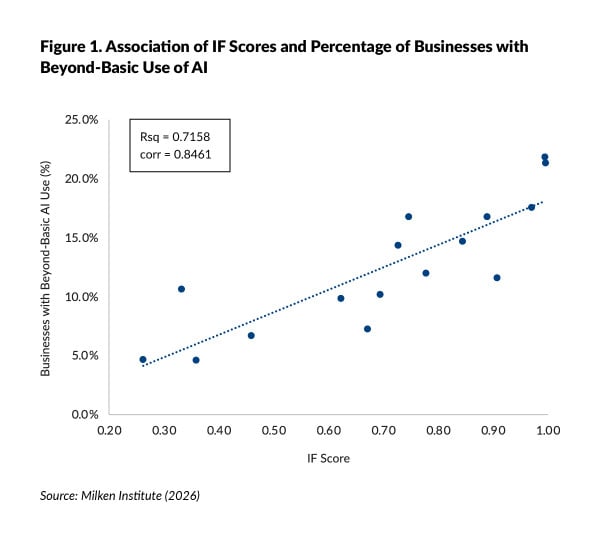
The GOI provides an objective benchmark for countries’ attractiveness to investors by evaluating global economies across five categories and fourteen subcategories. The five categories of the GOI—Business Perception, Economic Fundamentals, Financial Services, Institutional Framework, and International Standards and Policy—summarize the conditions that shape business outcomes, such as firms’ ability to scale new technologies. Examining the association between these five categories and the depth of AI adoption, we find that institutional conditions are the strongest predictor of firms’ ability to move beyond basic AI use. Indeed, simple regression analysis confirms that Institutional Framework (IF) scores account for approximately 71.6 percent of the variation in beyond-basic AI use (Figure 1).
Figure 1. Association of IF Scores and Percentage of Businesses with Beyond-Basic Use of AI
Cross-country comparisons reinforce the link between institutional quality and advanced AI use. In high-income European countries such as Belgium, Ireland, and the UK—all ranking among the top five nations in the IF category—about one-fifth of firms have integrated AI into core processes, using it for intermediate and advanced applications. This stands in contrast to European countries that score lower on IF, such as Greece and Poland, where only about one in 10 firms has moved beyond basic AI use. At the subcategory level, transparency and public governance show the strongest association with deeper AI adoption, underscoring the role of factors such as control of corruption and government effectiveness in enabling firms to scale new technologies.
Beyond institutional quality, financial conditions also play a critical role in shaping AI adoption. The Financial Services category is strongly associated with the share of firms using AI across countries, with access to finance emerging as a particularly important factor. This matters because survey evidence shows that, in most countries, more than one-third of firms report upfront costs as a key barrier to AI adoption. Over the past decade, venture capital (VC) investment in AI has diverged across economies: Countries such as the United Kingdom, Ireland, and Canada have seen steep increases in AI-focused VC investment per capita, while investment has lagged in many emerging and developing economies.
Taken together, these findings suggest that while AI adoption is now global, its economic impact remains unevenly distributed across countries. Widespread use alone is not enough to unlock AI’s productivity and revenue potential. Rather, what matters is whether firms operate in environments that support deep technological integration. Countries with strong institutional frameworks and well-functioning financial systems are far more likely to see businesses move beyond experimentation to scalable, value-generating applications. For policymakers and investors, the implication is clear: Closing the gap between AI adoption and AI impact—especially for countries like Poland and Greece, whose year-over-year adoption growth suggests they are positioned to leapfrog other European nations—will depend less on access to technology and more on strengthening the institutional and financial foundations that enable firms to deploy it at scale.
Maggie Switek, PhD, contributed to this article.