Food Is Medicine
Food Is Medicine (FIM) interventions are a spectrum of programs and services that respond to the critical link between nutrition access and health within the healthcare system. FIM interventions include produce prescriptions, medically tailored groceries and meals, and nutrition incentives.
Feeding Change responds to emerging needs in the FIM landscape by leveraging research and thought leadership to catalyze systems change, embed FIM interventions into policy and financing, and promote nutrition security.
To move this work forward, Feeding Change convenes the Food Is Medicine Task Force, a unique collective of more than 40 thought leaders from diverse sectors - including health insurance, food retail, healthcare, and health technology - committed to accelerating FIM implementation.
See our full list of Feeding Change Food Is Medicine Task Force organizations below.
Abbott
About Fresh
Ahold Delhaize*
Albertsons Companies
Amazon*
AmeriHealth Caritas
Attane Health
Bento
Blue Cross and Blue Shield of North Carolina Foundation
Blue Cross and Blue Shield of North Carolina
CareJourney
Centene Corporation
ChristianaCare
CVS Health*
DC Greens
Elevance Health
evermore*
CVS Health
FMI
Foodsmart*
Geisinger
Giant Food
Health Net
Hy-Vee, Inc.*
Instacart*
International Fresh Produce Association (IFPA)
iQPay
Kaiser Permanente*
The Kroger Co.*
Meijer
National Association of Chain Drug Stores (NACDS)*
NourishedRx
Point32Health
The Rockefeller Foundation
The Dolce Tyrner Foundation*
Savor Health
Season Health
SunTerra Health/Project FoodBox
Trinity Health
UnitedHealthcare
Virtua Health
Walmart
Women and Girls Advancing Nutrition Dietetics and Agriculture (WANDA)
*Indicates Business Council members
We are grateful to The Rockefeller Foundation for their support in launching and advancing the Feeding Change Food Is Medicine Task Force.
Identify and leverage scalable financing pathways
Leverage Feeding Change research projects to understand how to scale FIM programs in our healthcare system
Support FIM policy
Identify policy changes needed to improve FIM access and achieve alignment within industry on priorities
Elevate FIM
Provide visibility to the importance of FIM in public and private events, thought leadership, and publications
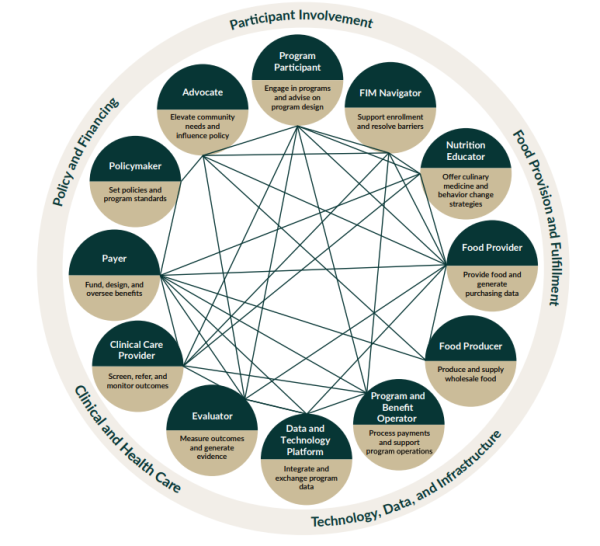
The Milken Institute Food Is Medicine Stakeholder Map outlines 12 key stakeholder roles, the function each contributes, and how they link to other FIM stakeholders. The map is featured in detail in "Activating the Food Is Medicine Ecosystem: A Framework for Stakeholder Partnerships.
Feeding Change introduced its first FIM stakeholder map in “Market Solutions for Scaling Food Is Medicine Prescriptions,” to illustrate the complex web of data and payment interactions among stakeholders across the field. In “Catalyzing Action for Pharmacist-Provided Food Is Medicine Care,” Feeding Change updated the map to include pharmacists and pharmacy technicians to emphasize the significant FIM care functions that they could perform. As FIM has expanded and evolved, Feeding Change once again revised the map in “Activating the Food Is Medicine Ecosystem: A Framework for Stakeholder Partnerships,” to center relationships as its primary purpose.
Related Power of Ideas Articles
-
 An Icon Showed Us the Way: Food, Medicine, and a Healthy AmericaIn the 1968 documentary film Out in the Rural, my mentor and friend Jack Geiger, MD—recognized as one of the founders of the US community health center movement and a champion of public health and health equity—states, “The determinants of health are in the social order, not in health care” and goes on to mention, “There are other priorities...food.”
 -
 When Food Is Medicine Leads: Integrating Access, Payments, and CareImagine an ecosystem where receiving care, accessing your personal finances, and shopping for groceries all run on shared, secure systems across health-care benefits, payments, food, transportation, and retail—synchronized to remove friction and reinforce healthy actions.
 -
 The Partnership Is the Innovation: Rebuilding Health from the Ground UpIn every conversation about health equity, the same phrase eventually surfaces: We need to meet people where they are. But what if we went further—and built systems that start where people are?
 -
 Why Food Democracy Matters in the Food Is Medicine MovementA poorly nourished community cannot effectively organize, but once fed and well, we can begin to envision and build a more just society.
 -
 Transforming Health Outcomes Through Strategic CollaborationSolving the complex challenges within our health-care system requires more than policy changes or technological advancements—it demands a deeper understanding of the social barriers individuals face. There is no one-size-fits-all solution.
 -
 Fighting Food Insecurity to Improve HealthWhen it comes to improving health, few opportunities are as obvious as Food Is Medicine (FIM). Nutritious food is essential to good health, and health-care organizations such as Centene are increasingly using FIM as a lever to drive better health outcomes and health-care savings.
 -
 Rooted in Health: How Agriculture and Health Care Can Grow TogetherWith chronic diseases on the rise and millions struggling with food insecurity, access to fresh, nutrient-rich fruits and vegetables has become more critical than ever.
 -
 How Health Care Can Lead the Food Is Medicine MovementFood and nutrition insecurity is a health issue far too big to ignore. Diet-related diseases are the leading cause of death in the US for adults.
 -
 Feedback, Ideation, and Iteration: The Key to Expanding Access to Food as MedicineTogether, we can ensure everyone has access to the nutritious food they need to live healthier lives.
 -
 Social Determinants of Health: It’s Always About the MoneyWe must be bolder and willing to leap beyond the status quo to uncover what truly moves the needle.
Activating the Food Is Medicine Ecosystem: A Framework for Stakeholder Relationships
Across the FIM ecosystem, stakeholders report unclear roles, misaligned incentives, and partnership structures that strain under the pressure of shifting funding and policy environments. Without intentional design, these challenges can limit efficiency, erode trust, and constrain the ability of FIM programs to scale and reach the people who need them most.
Activating the Food Is Medicine Ecosystem: A Framework for Stakeholder Partnerships is designed to address that gap.